
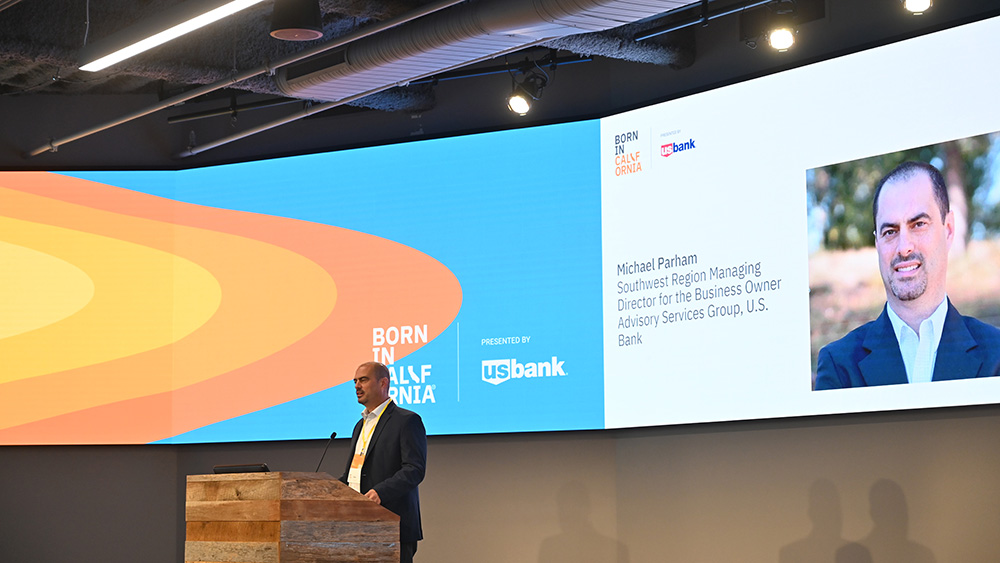
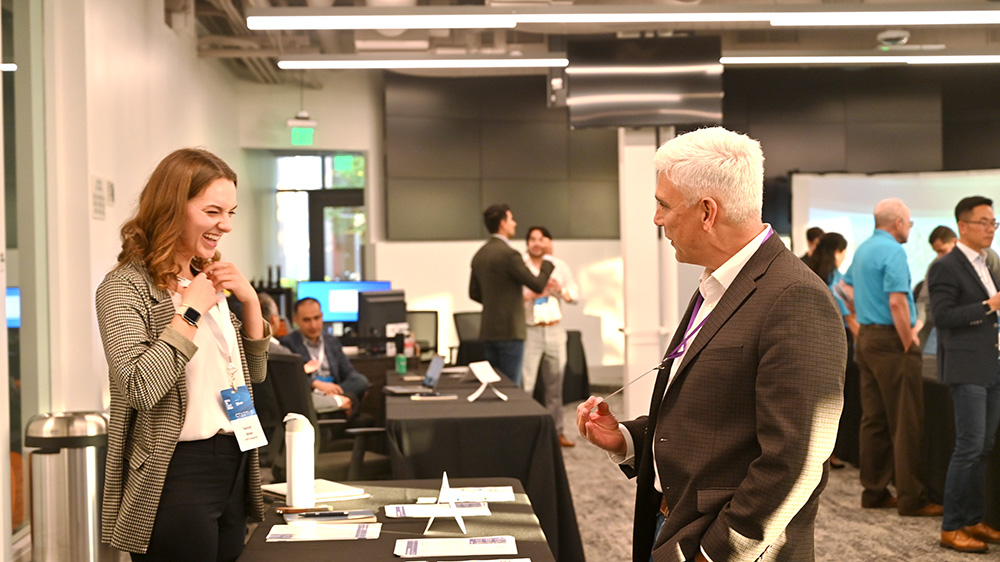

Born in California®, Presented by U.S. Bank, represents a significant collaborative intersection on the often-complex pathway of bringing University of California (UC) startups and their products to market. For many of the 38 startups who presented, their pathway has led them to the very edge of what UC resources can do for them; they are now relying on investors to help bridge them to the other side.
The one-and-a-half-day event offered startups an opportunity to establish demo stations where they could engage with investors and special guests before the pressures of their pitches on the following day. Demos on the evening of Day One provided for casual exchanges between startups, investors, and UC Irvine staff at a hosted reception run in parallel with startup pitch coaching sessions led by eminent mentors from across the region.
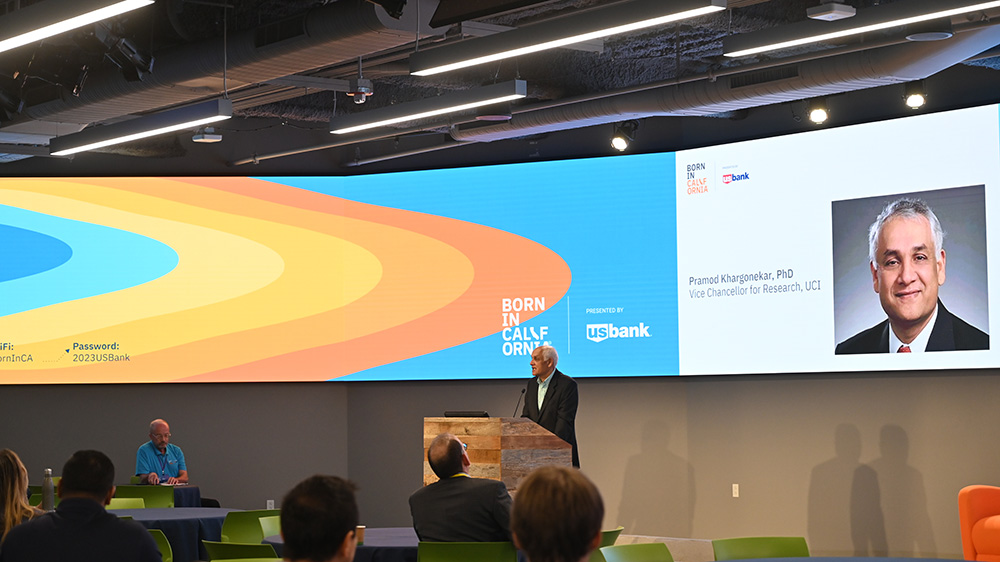
Kicking off pitch day, attendees heard messages from UC President, Michael Drake, UC Irvine’s Chancellor, Howard Gillman, as well as Provost and Executive Vice Chancellor, Hal Stern and Vice Chancellor for Research, Pramod Khargonekar.
Errol Arkilic, Chief Innovation Officer for UC Irvine, closed out the UC leadership comments, outlining the triad of engines that provide the innovation thrust — people, research, and impact.
Michael Parham, Senior Vice President and Managing Director, Business Owner Advisory Services, Southwest Region, U.S. Bank, voiced the sentiments and support of the three-time presenting sponsor, stating, “U.S. Bank has been proud to support this event. It’s groups and events like this that help keep California on top educationally, in job creation – not just in California, but worldwide – and in idea generation.”
“U.S. Bank’s steadfast and continued support for the innovative minds showcasing at Born in California year after year plays a pivotal role in empowering budding solutions targeting societal impact,” says Errol Arkilic.
Marc Tarpenning, UC Berkeley alum, Tesla co-founder and current investor addressed attendees in a pre-recorded video, remarking “It takes clever people, doing something new to push society forward and literally build the future in front of us. As it turns out, making something new is really hard, so I hope you are working on something you actually care about. It doesn’t have to be some world-saving idea, but it has to be something that you want to see in that future world.”
In an impromptu moment, previous Born in California participant Patrik Schmidle, CEO of Cari Health from UC San Diego, spoke to this year’s startups promoting the value of Born in California and how their experience in 2021 was a game changer when they met the fund managers from the Cove Fund which ultimately led to investment from the Southern California investment firm.
As pitches began, startups in the Sustainability track made it clear that batteries continue to be a hot topic. We heard from multiple startups, each with a unique twist on the market. Sodium-based battery startup UNIGRID from UC San Diego pitched a compelling argument for the mineral, leading with availability, low environmental impact, and no fire risk. UC Riverside startup Sulfuron, as the name suggests, seeks to bring sulfur-based batteries as a solution to growing global energy needs.
Addressing a different battery issue, UCLA’s Nuvola is focused on a component of batteries – the separator – which prevents physical contact between the anode and cathode and is a frequent failure point within batteries. Their innovation shifts from a film-based separator to a separation coating applied as a spray.
Another UCLA startup, forward-looking Active Membranes, is working on solutions to the UN-forecasted 2050 water crisis by developing a method to turn a “last resort technology” (desalination) into a reliable and eco-friendly method for converting brackish water into freshwater today.
The audience favorite and winner of the newly introduced California Gold Award, The Hurd, a startup from UC Santa Barbara, is using agriwaste – material that’s normally discarded or burned after food crops are harvested – instead of trees. Their product, Agrilose has half the global warming impact, less than a third of the acidification potential, and less than half the eutrophication (excess nutrients in lakes and rivers) when compared to eucalyptus pulp, the most sustainable option that is widely available today.
Moving into the consumer technology space, UC Irvine startup, Summit Technology Laboratory (STL), a B2B SaaS company, was a standout (and runner-up for the California Gold Award). STL is leading the next revolution in augmented reality (AR) by taking AR out of devices and projecting it onto the world around us in a natural, contoured, and interactive way.
“They’ve [STL] come a long way from projecting images on complex surfaces for art and ads to a platform for situational awareness, with a big goal of creating essentially a holodeck,” states Matt Hanson, Director, New Ventures at UCI Beall Applied Innovation.
Another UC Irvine startup, Squidtek, presented an amazing case of biomimicry. Taking inspiration from squids and their ability to edit their genes to rapidly adjust to temperature swings, Squidtek’s cutting-edge thermoregulatory fabric technology modulates temperatures in a vast range of applications to keep users comfortable or safe.
As one might expect, AI played a role in many emerging technologies presented. Investors heard from several startups employing the use of AI to address diagnostic accuracy and circumvent a lack of training, as well as analyzing speech to provide early detection of human diseases.
UC San Francisco startup CaptureDX is bringing AI-assistance to point-of-care ultrasound (POCUS) image capture, interpretation, and documentation to increase the use of diagnostic POCUS in the Emergency Department — increasing equitable access to expert-level healthcare.
Sensorygen, from UC Riverside, uses AI/computational biology to discover natural compounds to replace harsh/toxic chemicals in everyday products. The discovered compounds are then patented for specific applications and licensed to partners.
UC Davis startup ExpertIEP is an edtech platform that leverages AI and machine learning to empower parents and teachers of students with Individual Education Programs (IEPs) to reach their full academic and personal potential by adopting a computational approach to learner variability to develop pathways for individual learning styles.
On the AI flipside, due to the rise of AI, data center energy demand has skyrocketed. Lucidean, from UC Santa Barbara, is enabling next-generation data center networks with electronic and photonic integrated circuits for energy-efficient high-speed fiber-optic interconnect solutions.
UC Berkeley startup HOPO Therapeutics is developing novel medicines to treat heavy metal poisoning, including treatments for radioactive threats and the global health crisis of lead poisoning. Originally developed as a response to a nuclear blast, HOPO pivoted to a solution for heavy metal poisoning stemming from, and prevalent in, our everyday environment.
Protein Architects from UC Merced has developed One Shot Decoynostics for viral detection. The product binds and detects whole virus particles in seconds and low levels of detection. A major benefit when compared to PCR assay tests which suffer from a timeframe of 15 minutes to an hour and can provide false positive results long after infection recovery.
ReBlood RX from UC San Diego has successfully engineered an oxygen-carrying therapeutic known as PolyTghHb that is stable at room temperature for up to 2 years without the need for cross-matching in patients, addressing issues related to Remote Damage Control Resuscitation (RDCR). RDCR might occur on the battlefield, in pre-hospital emergencies, or wherever blood is not an accessible option.
For information on Born in California, please contact Matt Hanson, Director, New Ventures. For sponsorship or partnership opportunities, contact Grace Han, Director of Development.