What does it take to make a UC idea matter in the real world?
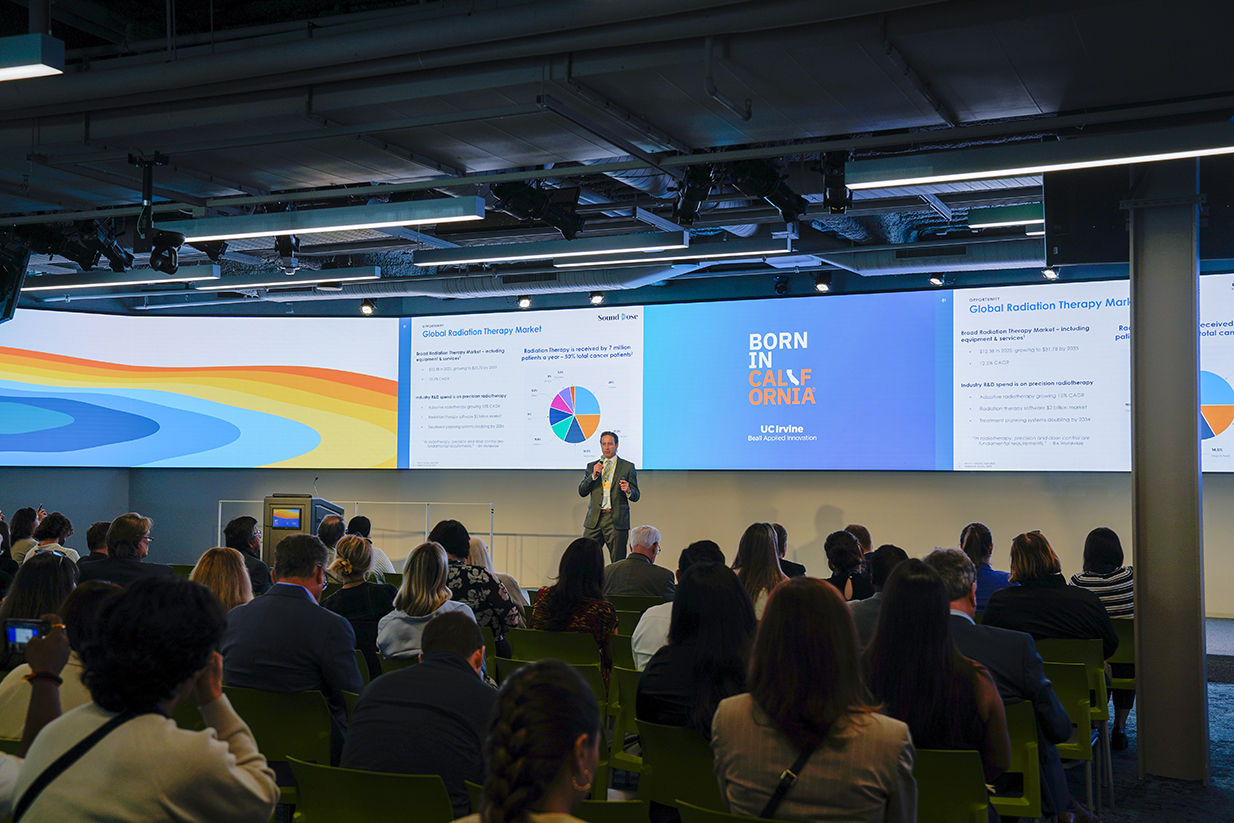
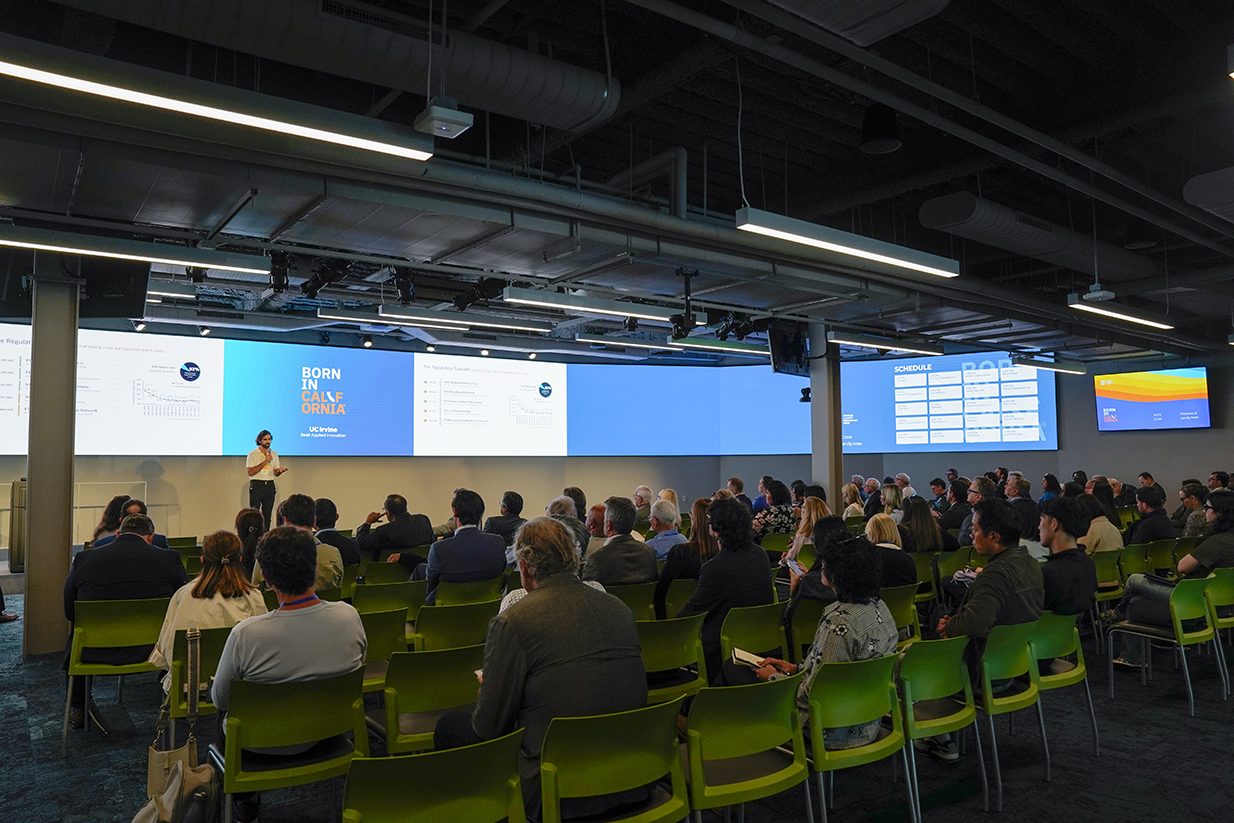
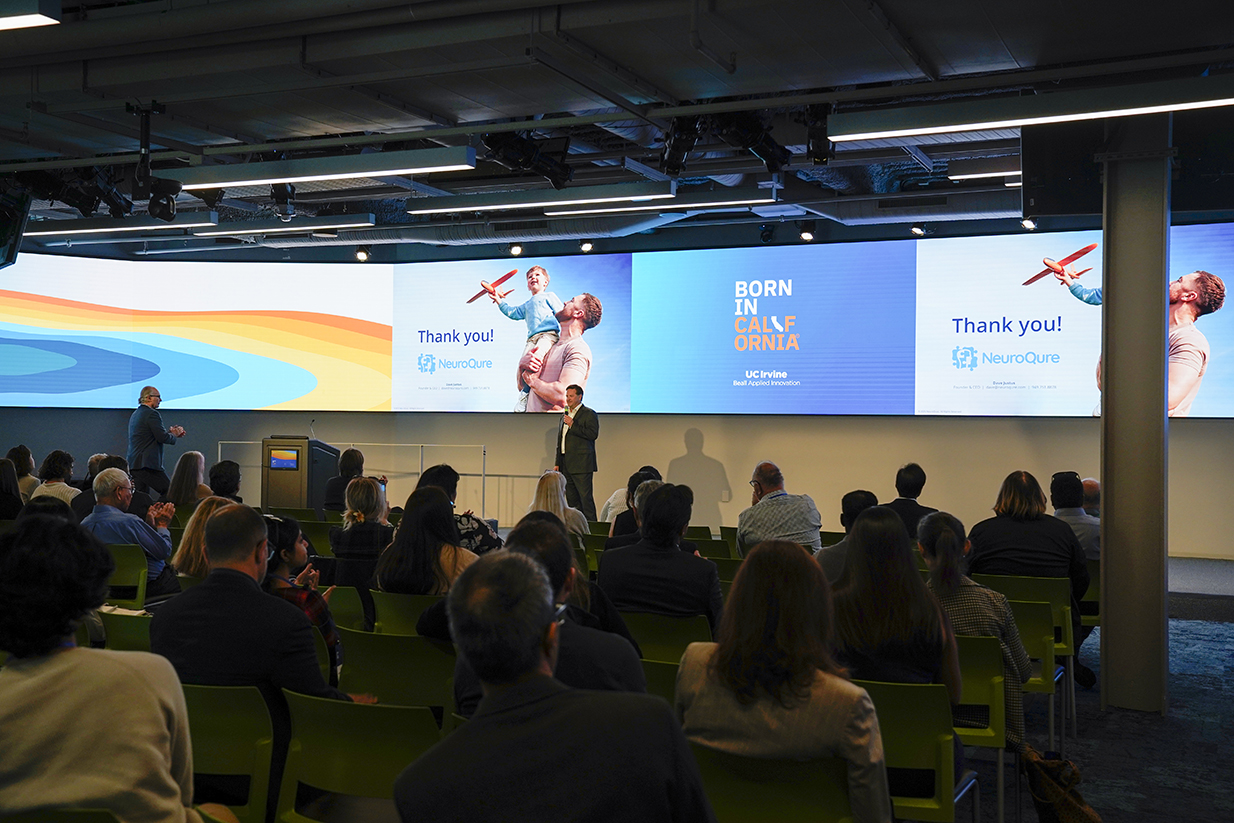
The timer starts at six minutes. Gregg Peterson, the co-founder of SoundDose, stands at the front of the room. He’s framed by slides stretched across a 132-foot screen that curves along three sides of the room. About 130 people sit in bright lime green chairs in neat rows. The space, inside UC Irvine Beall Applied Innovation at the Cove, is built for this moment. The audience is made up of investors, industry leaders, and other founders. The investors, especially, are watching closely. You can almost see them making calculations after every pitch.
On stage, Peterson is telling a story. Not about market size or how the technology is protected, although those details will be told later. His pitch begins with the story of a friend living with stage four throat cancer, a diagnosis traced back to radiation treatment she received for breast cancer three decades earlier, when the technology was far less precise. What saved her life then may have caused her current disease. It is a stark and human way to open a pitch about radiation dosimetry software developed by UC Irvine professor Liangzhong (Shawn) Xiang from the Department of Radiological Sciences and the Department of Biomedical Engineering. Peterson’s story is powerful, but not unusual. Nearly every founder who takes the stage seems to be driven by a similar loss, a gap, or a problem that became impossible to ignore.
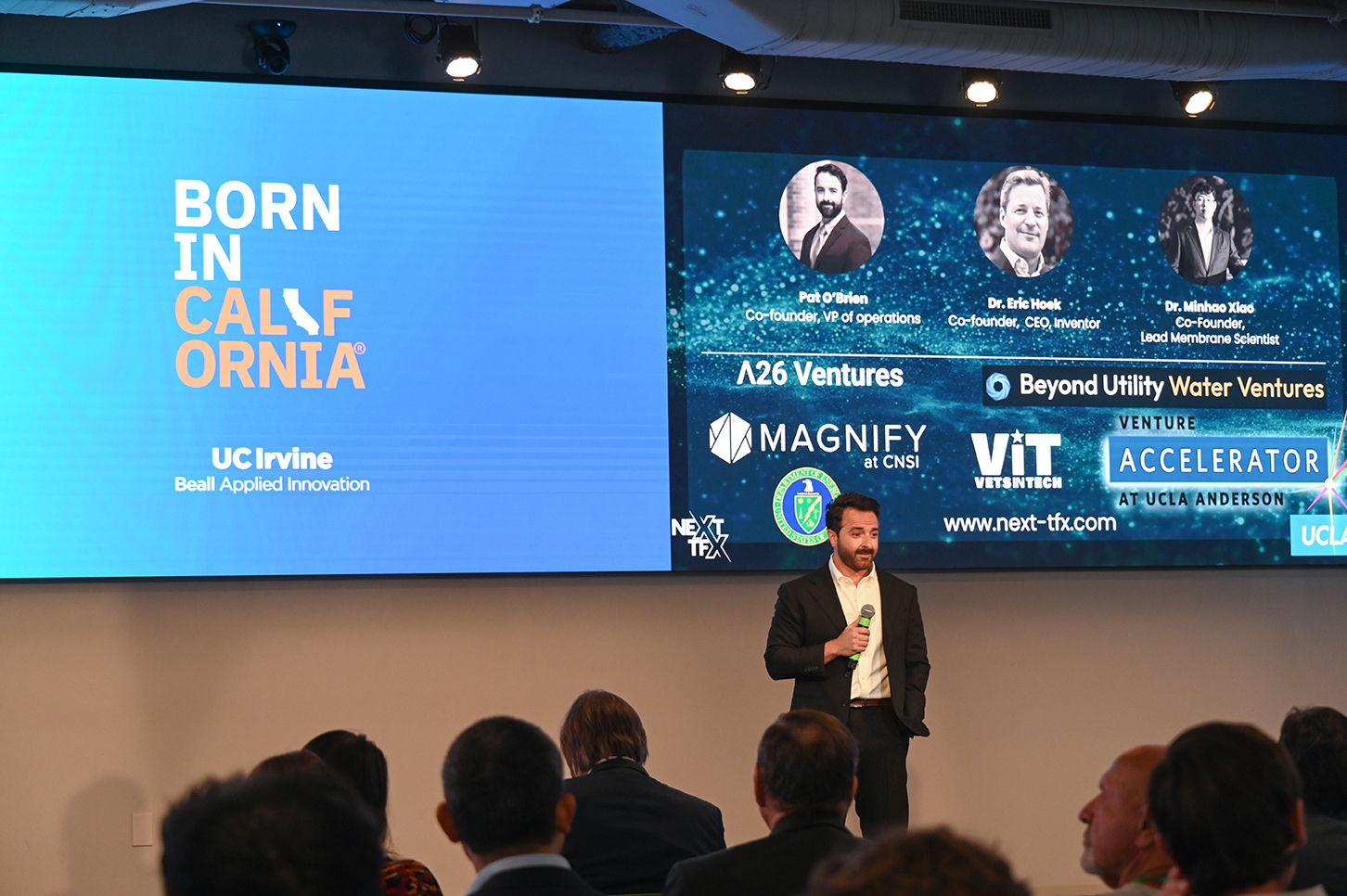
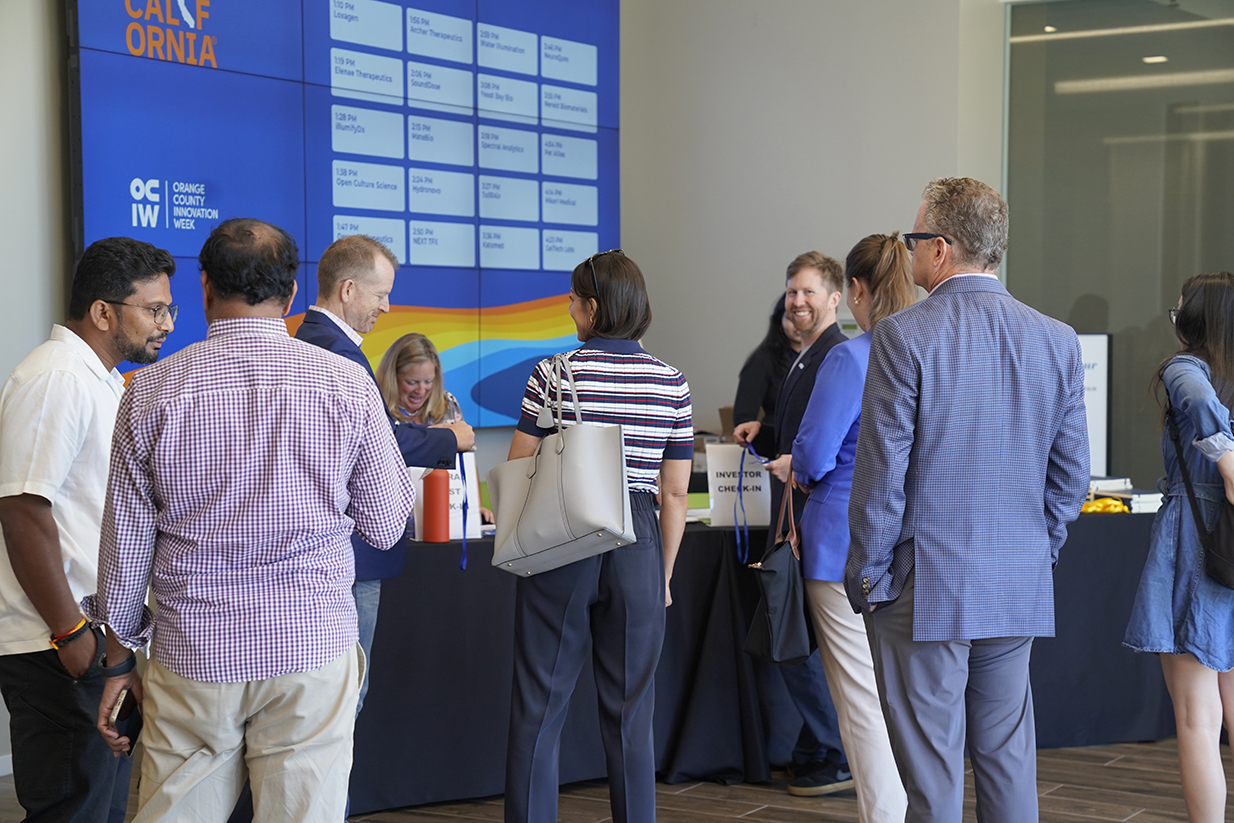
The room is gathered for Born in California 2026, the fourth annual pitch event that kicks off OC Innovation Week and features twenty startups from across the UC system. The event is designed to give investors and industry leaders a glimpse of UC’s emerging technologies. In person, it becomes a closer look at how research moves beyond the lab.
The Range of a System
Step back from the podium, and the scope of what’s on stage becomes clear. It represents ten campuses, from San Diego to Berkeley to Davis. Twenty companies touching cancer diagnostics, water scarcity, autism detection, ocean plastics, pest control, drug delivery, and the molecular architecture of chronic disease. The UC system is one of the largest public research universities in the world, and events like this one reveal that in addition to educating over 300,000 students each year, it is an enormous engine of intellectual property.
There are patterns in what these campuses are producing. Over the course of the afternoon, cancer comes up repeatedly as a shared priority across disciplines and institutions. Peterson and Xiang’s SoundDose, backed by $15 million in federal funding, is preparing to enter human trials with technology that tracks radiation delivery in real time, verifying that the dose went where it was supposed to go.
A few presentations earlier, illumifyDx from UC Davis reframes how cancer is understood.
“Cancer rewrites your entire body,” founder Maria Navas-Moreno explains.
The company has built a blood-based optical diagnostic platform, a new kind of liquid biopsy powered by AI. Instead of searching for tumor DNA, which many cancers do not shed, it reads the body’s molecular state to detect cancer sooner.
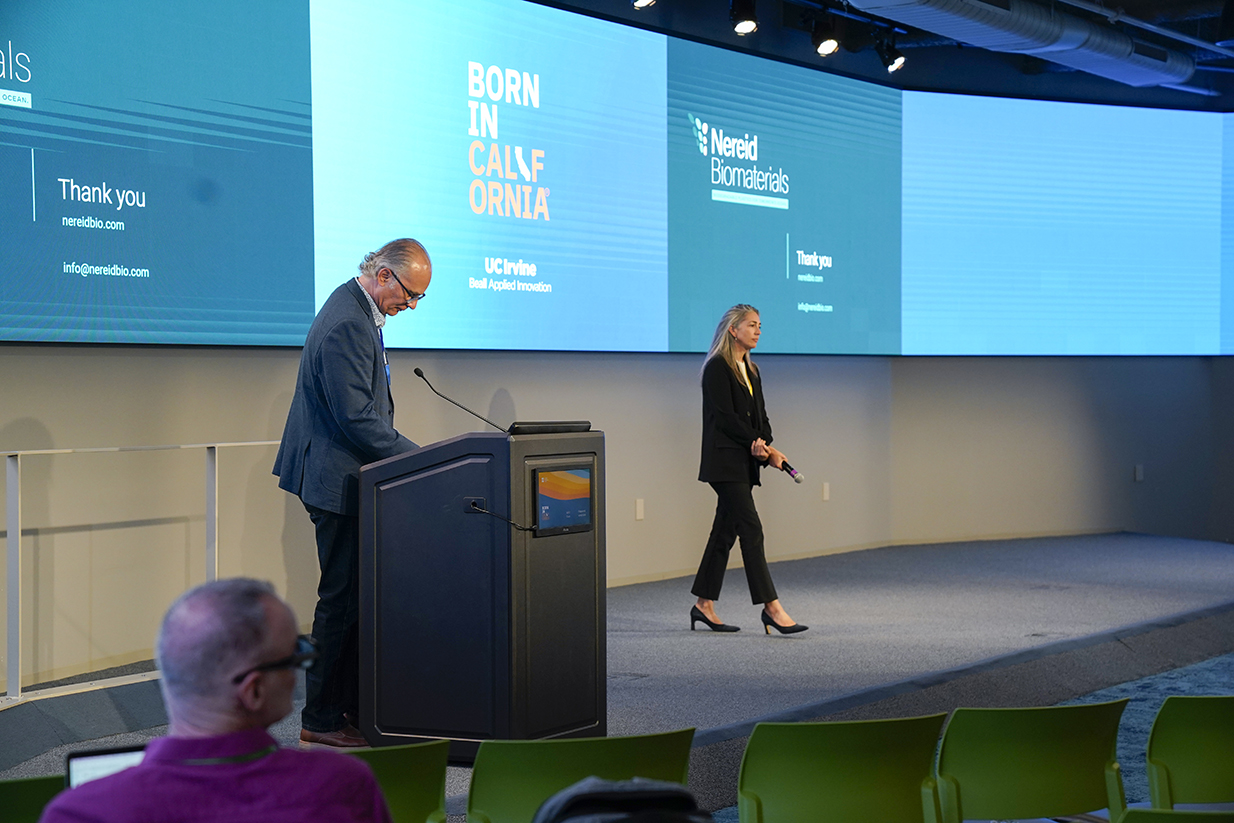
The focus on the environment is also strong. Nereid Biomaterials, from UC Santa Barbara, is developing ocean-degradable materials to replace the plastics that dominate marine industries. Water Illumination, from UC Riverside, has built a patented UV-driven system that destroys PFAS, the so-called forever chemicals, by breaking them into benign components without producing toxic waste.
Then there is Yeast Bay Bio, whose CEO and co-founder Nazzy Pakpour delivers a line that stops the room and causes everyone to laugh: “Everyone here is trying to save lives. I’m here to destroy them.” The focus of her startup is on cockroaches and other household pests, using species-targeted yeast technology posing no risk to people, pets, or ecosystems.
Later in the afternoon, the focus returns to human health. NeuroQure, based on research by UC Irvine Professor Emeritus John Jay Gargus, has developed what it describes as the world’s first biophysical test for autism risk at birth. A calcium biomarker detectable from a three-millimeter skin sample can be administered within days of life. Founder and CEO Dave Justus cites research suggesting that intervening earlier in a child’s development can increase IQ scores by up to seventeen points. The test is currently on the market and available in forty-six states.
What unites these companies across campuses and disciplines is not the subject matter but the starting point. Research that is rigorous enough to withstand peer review is now facing a different kind of test in the market. No one in the room knows which of these companies will still exist in ten years, or which will have the greatest impact. What happens next depends on what they build from here.

The Innovator Awards: Building Companies from Research
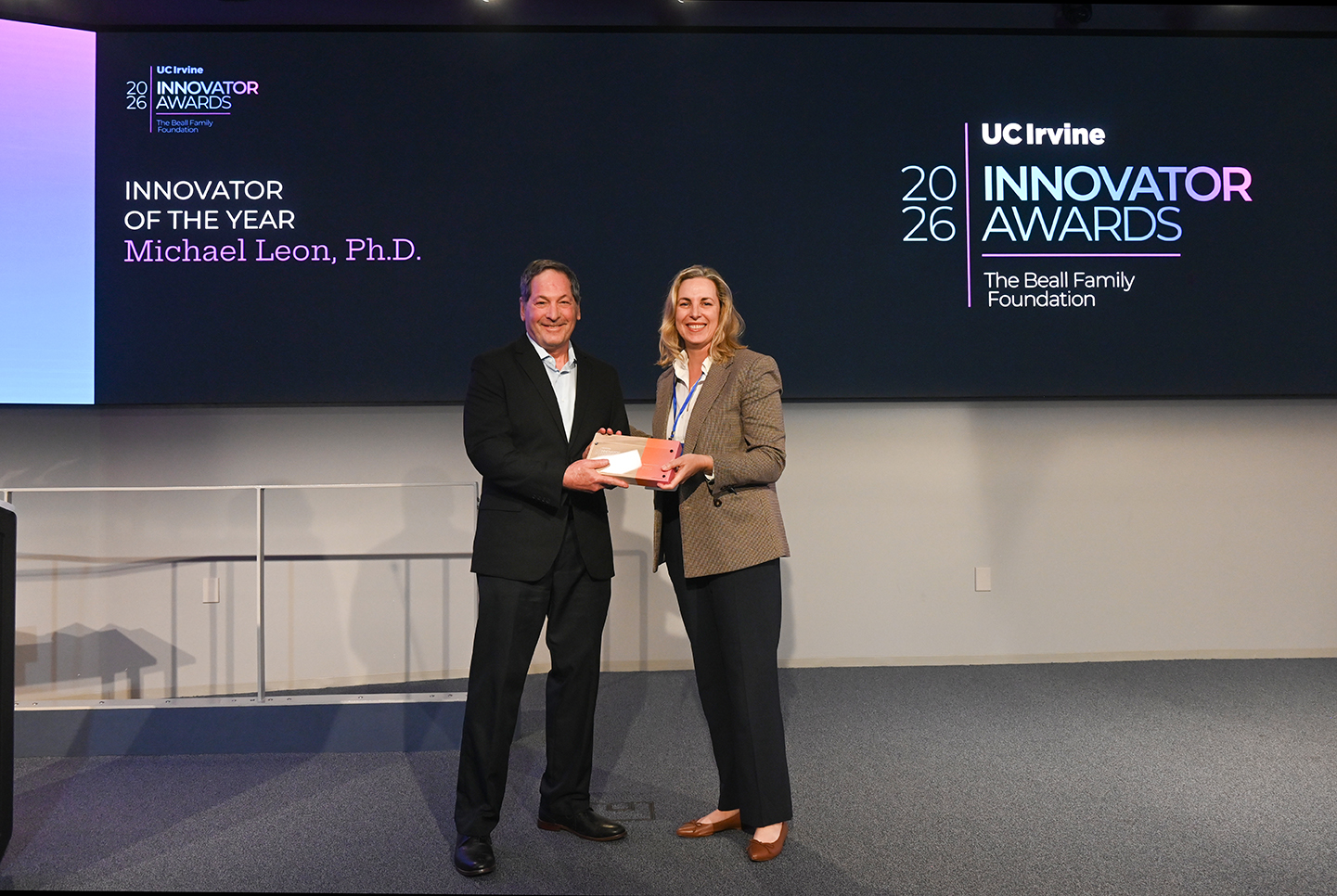
Later in the afternoon, the event transitions to UC Irvine Beall Applied Innovation’s annual Innovator Awards, supported by the Beall Family Foundation. The awards recognize UC Irvine researchers working to move intellectual property from the lab to market. Each winner receives $5,000 and, perhaps more meaningfully, recognition within a network that can help move the work forward.
Errol Arkilic, Chief Innovation Officer at UC Irvine, set the tone in his opening remarks by saying that “The privilege of this work is not simply witnessing the birth of an idea, but being present for its long, difficult journey into the world.”
The Early Career Innovator Award went to Xiang, the co-founder of SoundDose. Earlier that afternoon, his co-founder had stood at the same podium pitching the company built on his research. In his acceptance speech, Xiang shared that he lost his mother to cancer when he was nineteen, and later his older sister to the same disease. He understood, in a way that no amount of research training can teach, what disease takes from a family. “I told myself I’m going to do something about it,” he said.
Xiang was selected from a field that included Xiaoyu Shi from the Department of Developmental and Cell Biology and Department of Chemistry and Gulab Zode from the Department of Ophthalmology and Visual Sciences, both recognized for their demonstrated excellence at the intersection of research and early-stage innovation.
The Entrepreneurial Leader of the Year Award went to Robert Spitale of the School of Pharmacy and Pharmaceutical Sciences. He was recognized for creating new cell-based treatments for brain and nervous system diseases with his startup Savanna Biotherapeutics, Inc. Nominees also included Jesse Colin Jackson from the Department of Art and Cameron J. Ricks from the Department of Anesthesiology who were recognized as innovators who have taken university research to market and inspired others to do the same.
The Innovator of the Year Award went to Michael Leon from the Department of Neurobiology and Behavior, recognized for his startup Memory Air and his research into improving memory through scent. In his acceptance remarks, Leon spoke about the critical role of deep sleep in brain health. Nominees also included Mohammad Al Faruque from the Department of Electrical Engineering and Computer Science and the Department of Mechanical and Aerospace Engineering and Chang Liu from the Department of Biomedical Engineering and the Department of Molecular Biology and Biochemistry who were recognized as innovators whose breakthrough research has shown clear potential to transform lives and drive economic impact.
What is remarkable is not that some of these companies will succeed. It is that ten campuses across California are producing this volume and quality of research-driven innovation. Born in California and the Innovator Awards are not endpoints. They are markers of a system already in motion.