
Tom Milner, former UC Irvine professor of surgery and biomedical engineering, makes revolutionizing laser medicine sound easy.
“It was a pretty smooth path. The first time we tried it, we thought, ‘Hey, this looks like it’s going to work,’” he says about his work on lasers thirty years ago.
Milner, who recently served as the director of the Beckman Laser Institute, was a vital part of the team that invented the Dynamical Cooling Device (DCD), a medical device that sprays a cooling agent onto the skin before a laser pulse to enhance effectiveness and lessen pain.
The DCD developed from an epiphany, Milner’s colleague, distinguished professor of surgery and biomedical engineering J. Stuart Nelson, had while watching a player get hit by a “stinger” during a baseball game. He noticed how after the hit, a trainer would spray a cooling agent on the player’s injury to numb the pain.
Milner’s research team was in the midst of applying for grants from the National Institutes of Health (NIH) when Nelson wondered whether a cooling agent could be used in combination with lasers to cool and numb the skin. Over dinner, Nelson discussed his idea with Milner and visiting engineer Lars Svaasand, and the three agreed the idea had legs.
After spit-balling their ideas over the weekend, Milner went out to buy a valve while Svaasand and a student went down to the local Pep Boys to purchase R-134a, a refrigerant commonly used in automotive air conditioning systems. In the lab, they connected the refrigerant to the valve and controlled the valve with a delay generator that created a pulse to trigger the spray. In a short amount of time, their first prototype was built. The result: a breakthrough device that has since treated millions of patients and shaped the future of laser medicine.
Cold Comfort
Before the invention of epidermal cooling, the effectiveness of laser treatment was limited by the laser’s intensity. The heat caused patients pain, possible scarring, and pigmentation changes in the skin. Plus, the treatment wasn’t effective on patients with darker skin tones, since melanin in the epidermis, or top layer of skin, limited the amount of light that could reach the blood vessels that physicians were trying to treat.
When Milner first arrived at UCI in 1992, he was a research fellow joining Nelson’s team. Nelson, who is also the current medical director at the Beckman Laser Institute, was trying to come up with a more effective way to treat port-wine stains, hemangiomas, and other vascular malformations.
“We understood from the physics point of view that it was a question of how to make the skin really cold in a short amount of time,” Milner says.
The team’s challenge was to find a way to protect the outer skin while allowing the laser to penetrate deeper to the blood vessels that created these vascular abnormalities. They knew they needed to cool the skin; it was just a matter of how.
Before coming up with the cooling spray idea, the team’s original plan was to bring a cooled window onto the skin before quickly removing it.
“To me, this seemed a lot harder to build than spraying a liquid on the skin with a valve. Since I was the person who had to execute the solution, I preferred the new idea,” Milner says.
A Big Step Forward
The DCD works by delivering a quick burst of a cryogen or cooling agent, onto the skin immediately before, and often after, a laser pulse. The cryogen evaporates and the laser is triggered to target blood vessels in the dermis (the thick part of the skin under the epidermis). The technology is then incorporated into a handheld laser device that is used by a physician.
Once cooling was implemented to protect the skin’s surface, higher energy levels could be used to produce greater effectiveness. The technology also expanded treatment to patients of all skin types by mitigating the blocking effects of melanin. It also reduced patient discomfort by minimizing injury to the skin.
Dermatology chair Kristen Kelly was a research fellow at the time and worked with Nelson on studies investigating the DCD’s early uses.
“The DCD greatly advanced laser skin surgery. We’re able to provide treatment to a wider range of patients. It made the treatments less uncomfortable, and it helped to increase our efficacy. It really was a big step forward,” she says.
Cool Collaborators
Creating the device turned out to be the easy part. While the physical construction of the DCD presented minimal challenges, its complexity lay in comprehending its interaction with human skin. This is where Milner and his colleagues spent most of their time. They needed to measure the temperature of the skin as it cooled and the temperature of the skin when the laser was fired. They had to ensure their measurements were mathematically predictable and confirm their theoretical understanding of its behavior.

“Those were fun days. I had studied math, physics, and optics before arriving at Beckman. To see that being applied to medicine to help patients amazed me. It was a whole new experience.”
– Thomas Milner
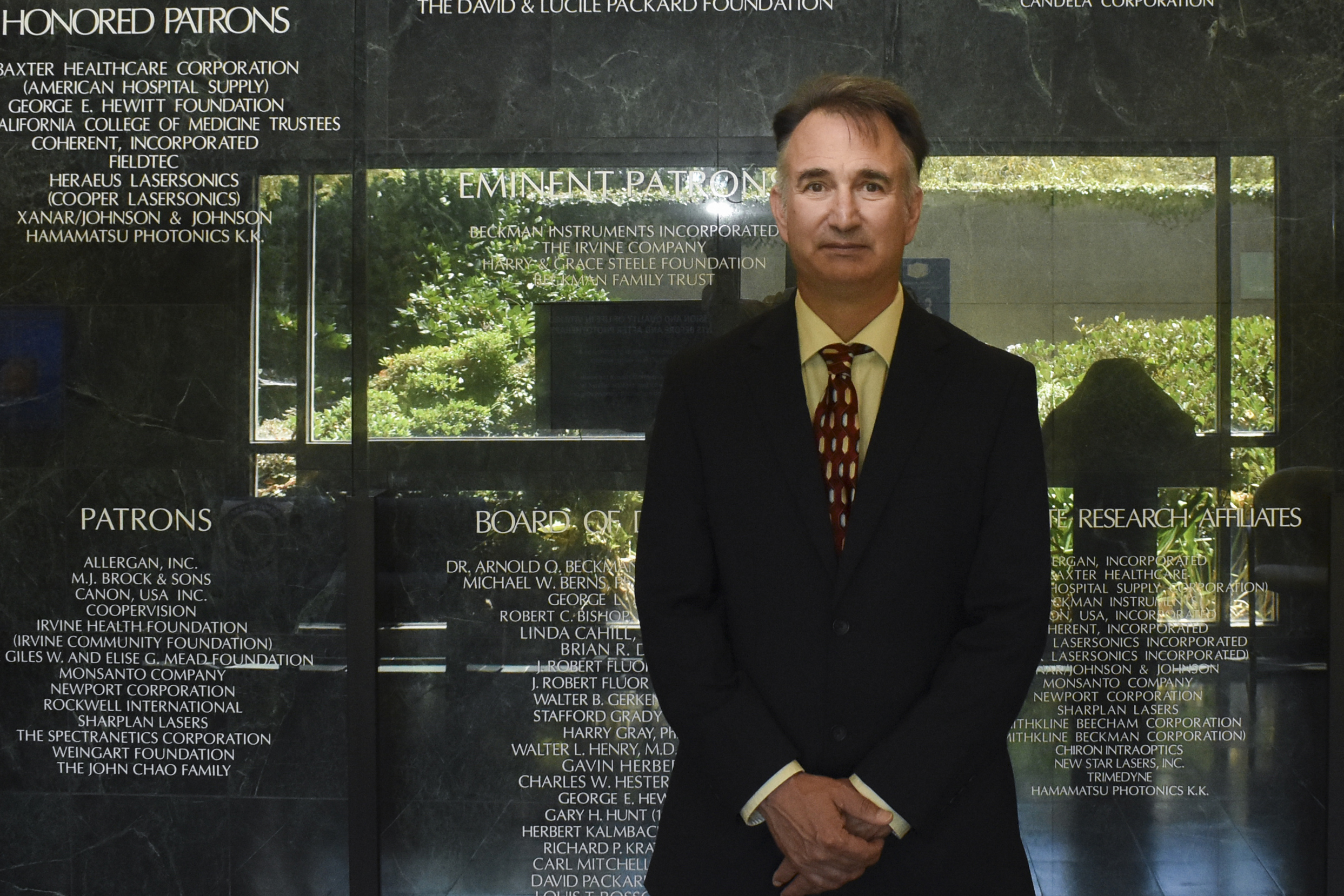
The success of the DCD was not just the result of technological innovation, but of collaboration across diverse disciplines to produce the technology. Samuel Tanenbaum, a visiting mathematician from Harvey Mudd College, contributed to the team by working out much of the DCD’s mathematical theory. Milner remembers when Nelson asked him if they should host Tannenbaum for a sabbatical.
“I knew when I saw Sam’s CV that he was a world-class mathematician,” Milner says. “I thought he would be fantastic. And he was.”
Another key collaborator was Salo or “Sol” Kimel, a chemical physicist from Technion – Israel Institute of Technology. Kimel spent two years of sabbatical and 18 summers as a visiting professor at UCI where he worked on various projects on campus. It was Kimel who came up with the idea of the fuel injector which serves to deliver a precise amount of cryogen onto the skin’s surface for the device. (When Kimel passed away in 2021, Milner, as director of the Beckman Laser Institute, helped to endow the Sol Kimel Memorial Endowed Graduate Student Award at UCI.)
Bahman Anvari was another integral part of the DCD team. Now a professor of bioengineering at UC Riverside, Anvari was a UCI postdoc when he worked on applying the DCD to other types of lesions, such as hemangiomas. He also collaborated with Tanenbaum on the mathematical calculations for the temperature response of the skin.
Cooling the Competition
The DCD was patented in 1998 and licensed soon after to the Candela Laser Corporation. The pivotal partnership began when Candela CEO Jerry Puorro visited the Beckman Laser Institute during a trip to Southern California. Puorro was immediately impressed by the DCD’s pain-reducing effects. Plus, its ability to protect the epidermis enabled it to treat a greater number of dermatologic conditions. This versatility, combined with its potential to alleviate discomfort, piqued Candela’s interest. The company, which specializes in medical aesthetic devices, acquired a license to the technology, and has primarily used it for laser hair removal. Candela gained an exclusive license to the technology and leveraged that into a dominant position in the laser industry. As for the University, the patent became a top generating invention for UCI and the UC system as a whole.
The Power of Partnership
The existence of dynamic cooling is tied to the existence of the Beckman Laser Institute, which first opened its doors in 1986. When the DCD was being developed, the Beckman Laser Institute was the only facility in the world to house laser-oriented basic science, engineering labs, and an outpatient clinic under one roof. In those days, its “from benchtop to bedside” motto was a radical concept. Plus, it was among the first to embrace transferring research from the laboratory to the marketplace by taking advantage of the Small Business Innovation Research (SBIR) Program. The program which is powered by the U.S. Small Business Administration encourages small businesses in the United States to engage in federal research and development with the potential for commercialization.
“I never cease to be amazed at inventions that were staring people in the face for a long time, and for whatever reason, they were never invented,” says Milner.
The idea of spray cooling wasn’t new to engineers but applying that technology to laser surgery had never been done before. Milner speaks about the often serendipitous nature of invention and refers to the invention of the laser as a prime example.
“All the ideas behind the laser were understood by the 1930s, but the devices themselves weren’t invented until the 60s. “A lot of times it just takes someone to act on the vision and just build it. It’s almost like they’re put in a box for someone to come by and open up.”
Since it was invented, the DCD technology and has been incorporated in over 20,000 handheld laser devices. Kelly, who continues to use devices with DCD technology in her clinic today, says, “I’ve been grateful for the opportunity to use it. It has improved patient care and enhanced our abilities as laser surgeons.”
The DCD stands as proof of the benefits of interdisciplinary collaboration and innovation. Scientists from different backgrounds contributed their expertise to create a breakthrough in laser medicine.
“The physicians didn’t know about this type of engineering and the engineers didn’t know about the problem that needed to be solved,” Milner says. “Simply putting them together made it all possible.”