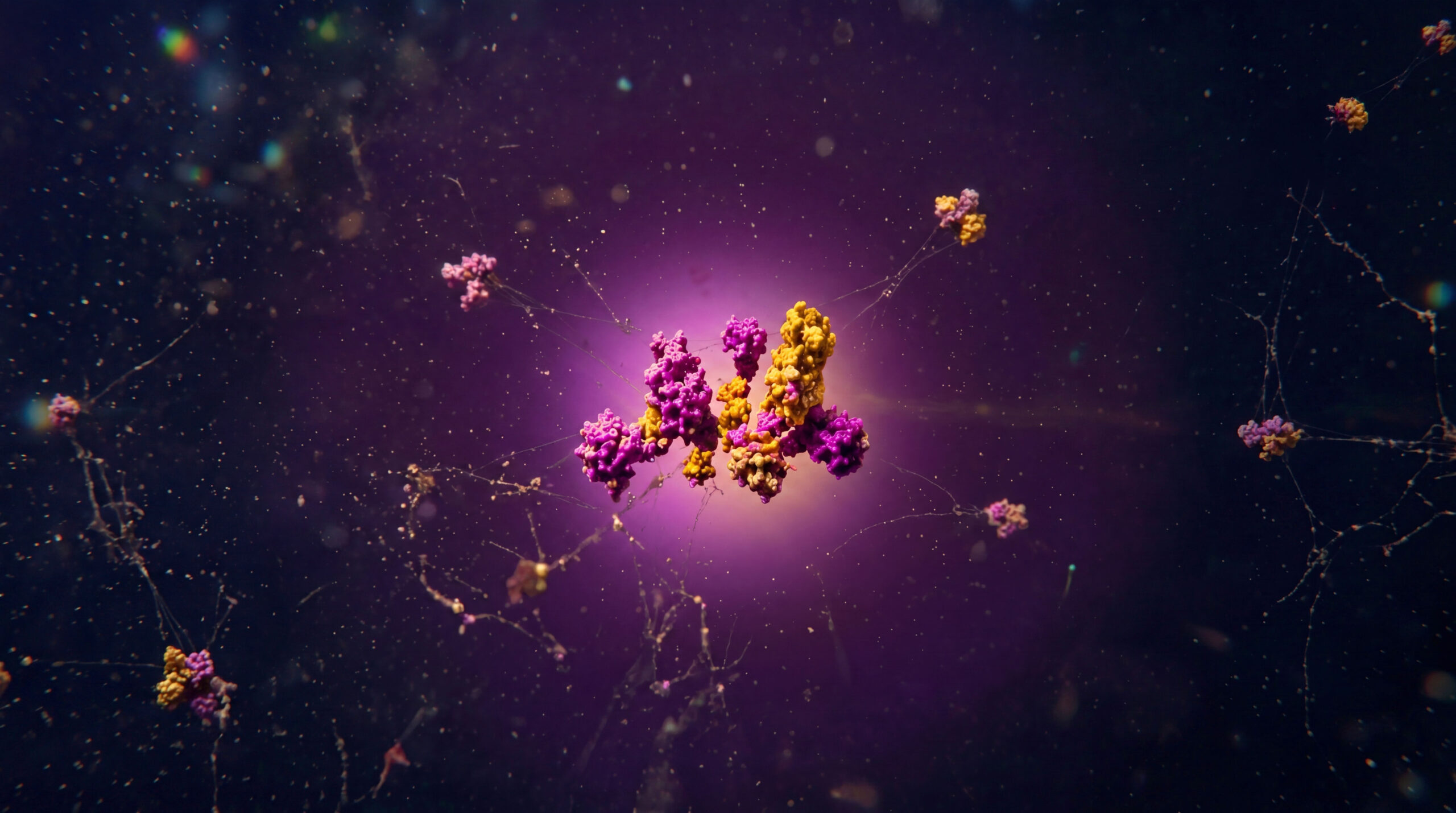
UC Irvine startup Cytoseen detects new drug targets for cancer and neurodegeneration.
When Xiaoyu Shi’s grandmother was diagnosed with Alzheimer’s disease, a question she couldn’t shake stayed with her. As a postdoc at UCSF, she began pressing colleagues: why, after decades of research, was there still no cure? When she accepted a faculty position at UC Irvine, home to one of 37 federally designated Alzheimer’s Disease Research Centers, she kept asking. The answer was always the same: the science wasn’t there yet.
For decades, research on Alzheimer’s treatment had centered on beta-amyloid plaques, the protein clusters that accumulate in the brain during late-stage disease. That focus produced important advances, but it also revealed a gap. By the time plaques appear, the disease has often been underway for years, driven by earlier molecular changes that no one could reliably detect. The precursors existed. The technology to find them did not.
“I realized I had a tool that could help,” Shi says. “Detecting low-abundance proteins is exactly what my lab’s GEMclear proteomics was invented for.”
That realization is what led her to start Cytoseen, the biotech startup Shi, now an associate professor of Developmental and Cell Biology at UC Irvine, with joint appointments in Biomedical Engineering and Chemistry, co-founded in 2025 with her CEO, Yang Liu.
The 90 Percent We Can’t See
To understand what Cytoseen is building, it helps to understand a foundational gap in modern medicine. The human genome encodes roughly 20,000 protein-coding genes, which give rise to a far larger set of distinct proteins. Proteins are the workhorses of biology. They carry signals, trigger immune responses, and tell cells when to divide and when to stop. They are also what most of the drugs are designed to target.
And yet, current pharmaceutical research focuses on a small fraction of them. By most estimates, only 10 to 15 percent are well-studied, and FDA-approved drugs target closer to 3 percent. The remaining 90 percent are largely understudied, not because scientists have ignored them, but because the tools to study them have been inadequate. Many of the most consequential proteins, the ones governing disease at its earliest, most treatable stages, are present in such small quantities that standard detection methods miss them.
To understand what these low-abundance proteins mean to health, Shi suggests thinking of traffic. Most proteins are like the cars on the road, abundant, constantly moving, easy to count. But what actually keeps traffic flowing is a much smaller, less visible system: the signals at each intersection. When the lights work, you barely notice them. When one fails, the whole network can grind to a halt. In the body, signaling proteins play that role. They are rare, decisive, and disease-specific. And until now, they have been exceptionally difficult to detect reliably.
Shi’s GEMclear proteomics technology works in two steps. First, the system chemically tags proteins at key signaling hubs, where the cell processes information and makes decisions. Then it removes the abundant background proteins that would otherwise drown out the signal. What remains is sent to a mass spectrometer, an instrument that identifies proteins the way a fingerprint identifies a person.
This is a meaningful distinction from what came before. Most current detection systems rely on antibodies, which can only detect antibody-targeted proteins, but not for the unbiased exploration of new drug targets. Cytoseen’s GEMclear platform can detect proteins researchers didn’t even know to look for, plus it’s 10 to 20 times more sensitive than existing methods.
The Right Partner
Shi and Liu met about a decade ago through a mutual friend. For years, their relationship was purely personal. They were two scientists navigating academic careers, both on the tenure track, both focused on publishing rather than commercializing their research. That changed around 2020, when Liu walked away from her tenure-track position. Shi’s first reaction was disbelief. ‘I thought Liu must have a great reason that I don’t know,’ she says. That great reason turned out to be entrepreneurship.
Liu had been trained as a pharmaceutical scientist, earning her Ph.D. at the University of North Carolina, Chapel Hill. She spent five years as a founding faculty member at Chapman University in Orange, California. But she had come to believe that academia, for all its rewards, was not the right setting for the kind of work she wanted to do. “Business rewards execution,” she says. “That’s where my strengths are.” She left her tenure-track position and spent several years working on a cloud-based services company, where she learned the mechanics of building something from the ground up.
Liu describes herself as someone who takes calculated risks, especially when the downside is capped and the upside could be life-changing. She and Shi sat down and mapped out what each of them wanted, what they valued, and where they might conflict. Even with that preparation, starting the company still took a leap of faith.
When Shi learned that Liu had left academia for entrepreneurship, she saw her friend in a new light. The two women were deliberate in deciding whether to build something together. What they recognized was not just shared ambition, but years of trust, a clear understanding of each other’s values, and complementary strengths shaped by different career paths. It was a foundation they believed would translate beyond friendship into a working partnership.
“People say, if you want to start a company, don’t go into business with your friends,” Shi says. “I disagree. It’s more important to choose the right person.”
Their initial focus is cancer and neurodegenerative diseases like Alzheimer’s. Within cancer, they are zeroing in on the environment surrounding a tumor, which largely determines how a cancer grows and whether treatment works.
The choices were not arbitrary. “Cancer and neurodegenerative disease still put the most burden on our aging people and on our entire healthcare system,” says Liu. “There are huge unmet needs.”
Born in Irvine
Cytoseen is a product of its place. “We really wanted our company to be born in Irvine,” Shi says. The intellectual foundation of the company developed in Shi’s lab, which is licensed to Cytoseen through UC Irvine’s Beall Applied Innovation. But the university’s support has extended well beyond IP licensing. Shi received a Proof of Product (PoP) grant, which helped support early development of the underlying technology to begin building the company. More than the money, Shi says, it was access to the ecosystem that came with it. It was the mentors, the guidance from the technology transfer staff, and access to UC Irvine’s broader innovation infrastructure that made a difference. “The award opened a door,” she says. “We received real support at every single step.”
Liu and Shi took part in I-Corps, the National Science Foundation’s training program for scientist-entrepreneurs, which sent them into the field to talk directly with potential customers. The program’s core message, that strong companies are built on existing needs rather than novel technology alone, pushed Cytoseen to focus on real-world demand rather than the capabilities of the technology itself.
That shift is beginning to show initial commercial traction. They’ve begun generating early revenue with research partners, helping to offset cost. Over time, core facilities are expected to become an important part of Cytoseen’s distribution strategy. Rather than building an operational infrastructure to run every sample itself, the company aims to establish a network of authorized providers that can offer the service at scale across the scientific community. By expanding capacity through these providers, the company can generate its proprietary dataset more quickly and make better use of that data over time.
Cytoseen is also in active pilot studies with two nonprofit research institutions. The goal is to formalize those pilots into official partnerships by the end of the year, a milestone Liu describes as the company’s most immediate priority. It would signal early market adoption and validate Cytoseen’s credibility.
Cytoseen plans to expand its R&D operations to the Cove, UC Irvine’s startup hub, which connects entrepreneurs with research, mentorship, and collaborative space to help move early-stage ideas toward commercialization. Shi hopes this is another way in which the university will help shape the company’s future.
“We want to take advantage of being small and nimble,” Liu says. “We want to talk to early users, pivot as needed and find a real product-market fit before fundraising.” The company is being intentional about timing and plans to raise venture capital at the right strategic moment.
You Cannot Treat What You Cannot See
A question can’t be answered until it’s asked. A target can’t be drugged until it’s seen. For decades, the proteins that drive early Alzheimer’s were simply too faint to detect, and so the question went unanswered. Shi has invented the technology, GEMclear proteomics, that reveals what had long remained invisible.
“My motivation,” she says, “is to relieve that suffering, from people we love, before it’s too late.”
For all its early momentum, Cytoseen is growing rapidly. The platform has demonstrated strong results across real-world research applications in Alzheimer’s disease and solid tumors. The team is now focused on fully automating the platform to meet the needs of large-scale drug target discovery in clinical and cell samples. The next phase will test whether the platform’s lab performance translates to broad adoption in drug development.
You cannot treat what you cannot see. By opening a window into the proteins that have long gone undetected, Cytoseen is betting that sensitive protein detection will lead to new drug discovery, earlier diagnosis, and ultimately, better patient outcomes. The targets are still being named. But for the first time, they are coming into view.