
By day, they were working to rethink how complex ingredients could be manufactured. By night, Britton was turning his rideshare gig into pitch practice for the startup they hoped to build. So, he pitched. And pitched. And pitched. Until one evening, driving a passenger from John Wayne Airport to Newport Beach, his story landed. The passenger pulled out her checkbook and wrote a six-figure check on the condition that she would do some due diligence on Britton and Weiss before he cashed it. That first investment got the company off the ground.
Debut, once an idea pitched from the front seat, is now driving the conversation. With Britton as founder and CEO, Debut has raised tens of millions in venture capital, signed strategic partnerships with L’Oréal and earned a coveted spot on the TIME100 Most Influential Companies list.
The Factory
To understand what makes Debut different, it helps to start with a grapefruit. Or more specifically, a molecule called naringenin found in grapefruit skin. It’s been known for years to improve skin elasticity and reduce inflammation. The only problem is that you need thousands of grapefruits (nearly a third of an acre’s worth) to produce a single kilogram.
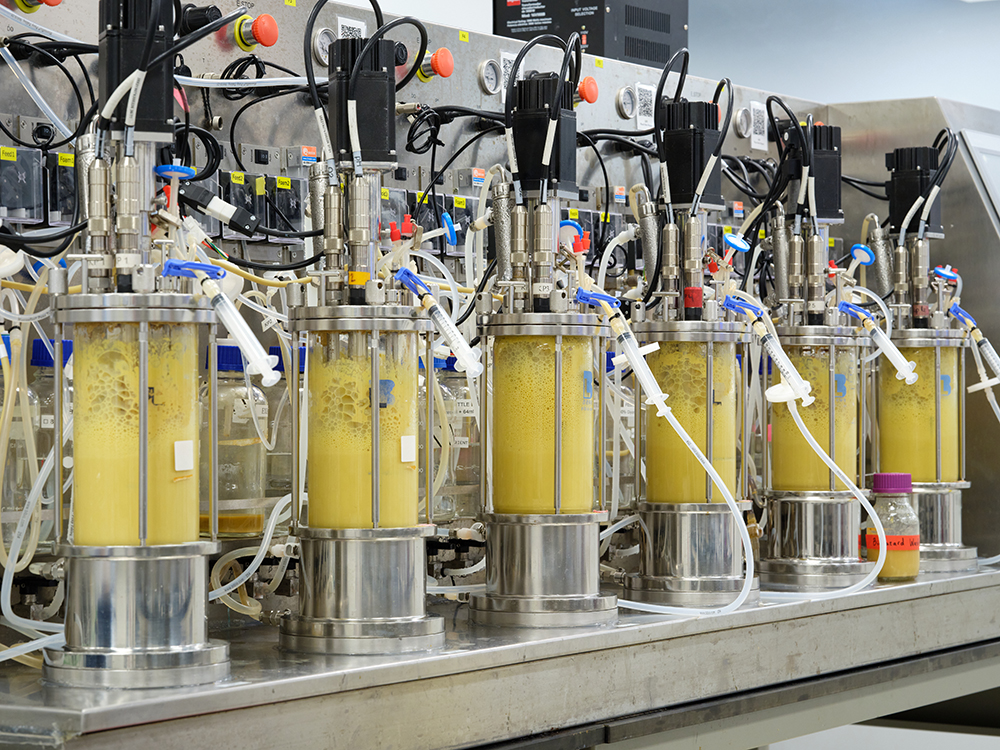
Instead of squeezing fruit, Debut ferments it biologically. By genetically programming microbes to produce naringenin in a lab, the company can recreate nature-identical molecules using a fraction of the water, land, and energy. Debut’s lab-grown naringenin is also 15 times more effective than niacinamide (a popular anti-inflammatory used in many skincare products) at lowering skin inflammation and reinforcing the barrier function.
“Our planet cannot afford to continue knocking down trees in rainforests to build more palm oil plantations,” says Weiss, who is also the former Director of Innovation at the UC Irvine School of Physical Sciences and co-founder of the company. “This is a chance to leapfrog the old ways of manufacturing and move into something much more efficient and better for the planet.”
Debut’s fermentation process is part of a broader toolkit that includes both cell-based and cell-free biomanufacturing. While traditional fermentation uses living cells to produce materials, cell-free systems extract only the enzymes needed, removing the metabolic overhead of keeping a cell alive and funneling that energy directly into the production process.
“We wanted to drive a synthetic biology revolution using cell-free biomanufacturing,” says Weiss. “Instead of relying on petroleum or natural extraction, we’re creating a third way to make things: using biology as the factory.”
“We wanted to drive a synthetic biology revolution using cell-free biomanufacturing.”
From Molecule to Marketplace
The vertically-integrated company has built out a full pipeline to get novel molecules from test tube to store shelf. Traditional ingredient development can take years and often depends on unstable harvests or petroleum-based processes, which not only use a nonrenewable resource but also generate significant carbon emissions during extraction and production. Debut’s system compresses the timeline dramatically while reducing environmental costs and increasing resilience. Debut’s precision technology also enables the creation of novel ingredients at lower concentrations, delivering targeted performance, personalization and enhanced potency.
Its AI platform, BeautyORB™, can screen upward of 50 billion compounds via computer modeling to predict how each might influence skin biology. And they’re not limited to what’s found in nature.
“What would take 100,000 years using traditional approaches can be done in several months or so computationally,” says Britton. “This allows us to find and create novel ingredients in record time, enabling us to access ingredients no one has ever seen before.”
Unlike traditional companies that rely on a limited catalog of existing molecules (often extracted from nature or sourced from suppliers) Debut designs its own. By creating ingredients from scratch through precision fermentation and enzyme engineering, the company avoids the variability of natural harvests and maintains strict control over purity, potency, and performance from the very start.
That degree of control doesn’t just accelerate development. It reduces waste, avoids seasonality, and makes the entire supply chain more resilient. In many cases, the resulting bioactive molecules outperform their naturally derived counterparts.
And the industry is taking notice.
Debut partners with multinational companies, including L’Oréal, the world’s largest beauty company, to supply next-generation ingredients that align with its commitments to innovation and sustainability. Through a separate partnership with KDC/one, a leading contract manufacturer, Debut’s ingredients are being formulated into finished products across multiple brands and categories.
The company has also launched its own skincare brand, Deinde, which only uses Debut-developed ingredients. This gives them end-to-end control from AI discovery to biomanufacturing to finished product.
Beyond Beauty
While beauty might be Debut’s proving ground, the company’s ambitions stretch further. In 2024, Debut unveiled a molecular replica of carmine, a vibrant red pigment historically made by crushing cochineal beetles. It’s used in everything from lipstick to food coloring to dietary supplements. With growing demand for cruelty-free, vegan alternatives, and mounting regulatory scrutiny of synthetic dyes like Red No. 3, Debut’s lab-grown carmine has the potential to shift supply chains across industries.
Even the U.S. government saw potential in the platform. In 2024, Debut received a Department of Defense contract to help design a large-scale domestic biomanufacturing facility. It was part of a national push to bring critical materials production back onshore. Though the effort was paused due to shifting federal priorities, it highlighted Debut’s broader relevance beyond beauty.
This expansion speaks to something bigger: synthetic biology (reprogramming cells to produce new materials) is no longer confined to pharma. It’s finding traction in industries where consumers care deeply about performance, safety, and sustainability, but where the supply chain has been slow to evolve.

“Scientific discovery has always been the driver for me.”
The Business of Redefining Beauty
Leading this shift is someone who’s been outpacing the field since his earliest days at UC Irvine. Even as a visiting Ph.D. student, Britton stood out.
“He was completely on fire,” says Weiss. “As he read the literature, he was constantly looking for ways to advance his science based on current research. He would come up with an idea, and literally a few weeks later, we’d be writing a paper.”
In just nine months in Weiss’s lab, Britton co-authored a significant number of publications. Over the course of his Ph.D., he published 20 papers—a staggering figure in a field where most chemistry students graduate with between two and five.
Britton’s leap from Ph.D. student to CEO of a TIME100 company isn’t just a personal success, it’s a marker of where science and business are converging. This shift isn’t just aesthetic, but infrastructural. Behind every Debut ingredient is a system of AI discovery, precision fermentation, clinical testing, and enzyme engineering that looks more like a pharmaceutical pipeline than a cosmetics lab.
And that’s the point.
Debut represents a transformation of not just what goes on your skin, but how the beauty industry protects its future.
“Scientific discovery has always been the driver for me,” Britton says. “Redefining product performance and achieving new heights of innovation drives all that I do.”
What began in a university lab has since grown into a company capable of securing its own supply chain, launching its own consumer brand, and shaping how future products are made.
The beauty industry is undergoing a transformation. And Britton, who once pitched his idea to strangers in the backseat of his car, is now sitting behind the wheel of a company helping to drive it.