
What if materials weren’t just made, but designed in tune with nature?
Every jacket, shoe, and coated surface carries a hidden cost, one measured in emissions, water, and waste. But what if materials could be designed differently from the start? What if they were rooted in biology, built to last, and designed to break down safely back into the earth? That’s the premise behind Ecotune, a startup founded by UC Irvine alumna Ella Csuka, whose bio-based, plastic-free materials take cues from nature to rethink what sustainability can look and feel like.
More Than Skin Deep
The idea for Ecotune took shape after Csuka graduated from the School of Biological Sciences, where she studied the molecular structure of skin. Through research on biological structures, she became interested in how the body builds strong, flexible materials using just a few core components: collagen and elastin. Collagen provides strength to our skin while elastin allows the tissue to stretch and return to form.
That balance, between structure and movement, durability and softness, is what makes skin perform and gives leather its appeal. But traditional leather comes with environmental and human costs, like deforestation, high carbon emissions, and exposure to toxic chemicals from tanning and dyeing. Synthetic alternatives aren’t much better. Most are coated in plastic and made from petroleum-based polymers like polyurethane or PVC, which shed microplastics and contain known carcinogens.
That realization inspired her with a vision. Instead of limiting designers to leather or plastic alternatives on the market, she set out to innovate a new material that could match their performance while meeting a much higher standard of sustainability.
“Starting Ecotune brought together everything I care about — sustainability, nature-inspired design, and my background in science and research,” she says. “After learning more about the environmental impact of the fashion and materials industries, I realized I had a skill set that could help solve these challenges.”
Rethinking What Materials Can Be
Ecotune’s materials are made entirely from plant-based sources, including custom bio-based polymers (the molecular building blocks that give materials their structure) developed in-house. These long chains of repeating molecules determine the material strength, flexibility, or stretch, depending on how they’re arranged. It’s a structure found throughout nature, from plant fibers to the proteins that give human skin its strength and elasticity.
Designed from the molecule up, these materials offer the strength and flexibility of luxury textiles, while bypassing the environmental costs of plastic or leather. They are USDA-certified 100% bio-based and have been tested to hold up under real-world conditions, demonstrating resistance to abrasion, flex, tear, and water.
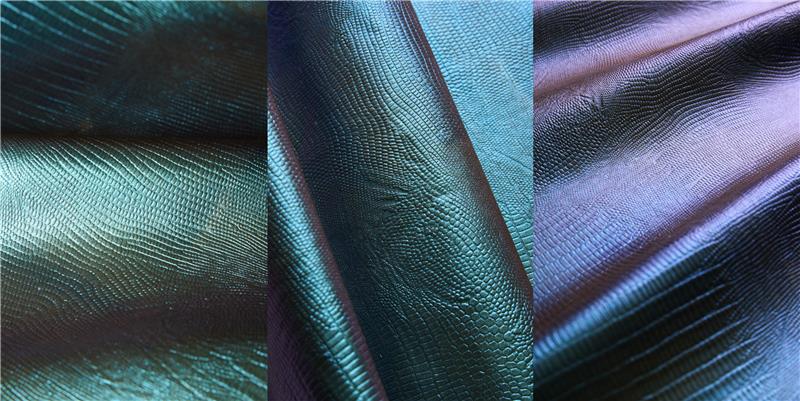
While many mimic the elegance of leather, others lean into a futuristic style, with iridescent surfaces that shift with the light or textured finishes reminiscent of carbon fiber, creating material that would look at home in a sci-fi film or a superhero’s wardrobe.
Csuka sees taste shifting too. “Designers and product developers are leaning toward a new aesthetic,” she says. “We’re now asking: How can we reveal the true nature of this material through its design?”
Color is another area where the company is pushing boundaries. Instead of using petroleum-based dyes, which are a major contributor to industrial water pollution, Ecotune incorporates natural pigments directly into the material. The process eliminates wastewater and allows for more nuanced, naturally inspired tones.
Funding the Next Phase
While Ecotune has grown beyond the lab scale, UC Irvine is still part of its story. The company uses the campus’s Irvine Materials Research Institute as an industry user, giving it access to specialized equipment for materials testing and development. In addition, many of Ecotune’s early team members came out of UC Irvine, and the company was an early participant in Wayfinder, UC Irvine Beall Applied Innovation’s former startup incubator.
That foundation helped Csuka secure a series of highly competitive grants. Ecotune received funding from the U.S. National Science Foundation, including a $1.2 million award to scale its production. The company has also been funded by the U.S. Environmental Protection Agency, which named it one of the top 30 environmental startups in the country. Additional support came from the Biomimicry Institute and the 776 Foundation, which chose Ecotune from 1,500 applicants as one of 20 climate-focused startups worldwide.
The industry has also taken notice. Major global brands in fashion, footwear, and the automotive industry are approaching the company as they look for ways to meet increasingly urgent sustainability targets and climate action goals. Plus, the opportunity to fill this market gap is immense. The global leather market is worth $86 billion annually, with bio-based alternatives already making up a $1 billion segment that’s growing 6% each year.
But Ecotune’s platform is not limited to textiles. Its materials could also be used in films, filaments, foams, or anywhere high-performance coatings are needed. These applications fall within the broader advanced materials market, which is valued at over $228 billion.
This is where materials become more than a design choice. Studies show that raw materials can account for up to 70% of a product’s total environmental footprint. When it comes to meeting climate goals, materials may be the most important lever companies have and the hardest one to overlook.
Building Toward Scale
Creating a new material in a lab is one thing. Scaling it is something else entirely. It’s not just about producing more. It’s about meeting industry standards at consistent quality and fitting into existing supply chains and pricing models.
“For a next-generation material to be adopted, three key features have to intersect,” Csuka says. “It has to perform at least as well as what it’s replacing. It has to be scalable with strong unit economics. And it has to be meaningfully more sustainable. If it misses any one of those marks, it won’t make it.”
That thinking shapes how Ecotune designs everything. The material platform is flexible and can support different looks and properties depending on the use. And the textile layers, what sits beneath the coatings, are sourced with care. The company uses certified organic cotton, regenerative Climate Beneficial™ verified cotton, and TENCEL™ lyocell, a wood-based fiber produced in a closed-loop process that recycles water and solvents with minimal waste.
The structure of skin may have sparked the idea, but Ecotune’s materials are shaped by broader lessons from nature. Sustainability means more than just using plants. Materials are built to last but also designed to break down safely at the end of their life. Because the resources are renewable and responsibly sourced, they also support carbon capture, soil health, and biodiversity. To better understand and communicate this impact, the company is conducting a life cycle assessment measuring emissions, water use, land impact, and energy consumption.
By designing materials that are circular and perform well, Ecotune isn’t just offering a better substitute, they’re opening the door to an important set of questions. What should sustainability look and feel like? What do we expect from the materials we use every day? And what happens when we truly design for the future?
As industry adapts and climate policy tightens, these choices are no longer abstract but have real-world consequences. While Ecotune is still in its early stages, their vision is clear. The future of materials doesn’t need to mirror the past. It can offer something new entirely.