
Memoirs are static. Lectures are one-way. Books gather dust. What if wisdom talked back?
That’s the premise behind Elder Wisdom, a pilot project at UC Irvine’s Beall Applied Innovation. Developed through its NarrA.I.tive initiative, the platform creates AI-powered avatars designed to make memory conversational. Instead of roaming the internet, the system draws on curated collections of personal writing (memoirs, letters, interview transcripts), allowing the avatar to speak with the cadence and perspective of a real person.
To test the concept, the team turned to the memoir of Edward Mathews, a World War II veteran, longtime insurance executive, and family historian who spent years writing nearly 400 pages of his life story. That record became the raw material for the first Elder Wisdom prototype.
For Mathews, the memoir was meant as a guide, so his children would understand where they came from, what shaped their parents, and by extension themselves. He didn’t see his work as a grand history, but as a starting point for his descendants to carry the family story forward.
His son, Stuart Mathews, who leads the NarrA.I.tive initiative and is the Director of Industry Alliances at BAI, took that vision seriously. When the NarrA.I.tive Story Studio began experimenting with conversational avatars, he saw in his father’s memoir the perfect test case. Why not turn the text, and the man behind it, into a digital persona? He knew his father’s story so well that he could tell instantly if the digital “Ed” strayed from the truth or hallucinated.
After months of combing through his father’s files, assembling them into a manuscript, and feeding them into the system, the moment he first interacted with his father’s avatar felt deeply emotional. The voice was familiar, the cadence right. More than a recitation of words, the avatar carried something of his father’s personality, his way of telling stories with a touch of humor and plainspoken wisdom. Not only was the moment poignant, but it also felt like a huge win, something akin to “winning the Super Bowl.”
Talking to the Edward Mathews avatar feels a little like joining a Zoom call with someone who isn’t actually there. The screen comes alive with his likeness, and a steady voice, touched with the cadences of another era, answers back. In one demo, Stuart Mathews greets his father’s digital self:
“Good morning. How are you today?”
“Good morning. I’m doing just fine today. Thank you for asking. At 99 years old, I wake up grateful for each new day the Lord gives me. My old bones creak a bit more than they used to, but I can’t complain. How are you doing on this fine day?”
The effect deepens when the questions grow personal. Asked about his late wife Martha, the avatar recalls the August afternoon in 1948 when they married, the dress her mother sewed, the nerves he felt at the altar. None of this is fabricated. The responses are drawn from memoirs, letters, and recordings, stitched together into a conversational whole. What makes the exchange uncanny is less the accuracy of the facts than the way the answers carry the rhythms of a man who is still very much alive, but whose stories now live on in another form.
The innovation isn’t just personal. It also signals to leaders at UC Irvine Beall Applied Innovation that the project has value beyond one family’s story.
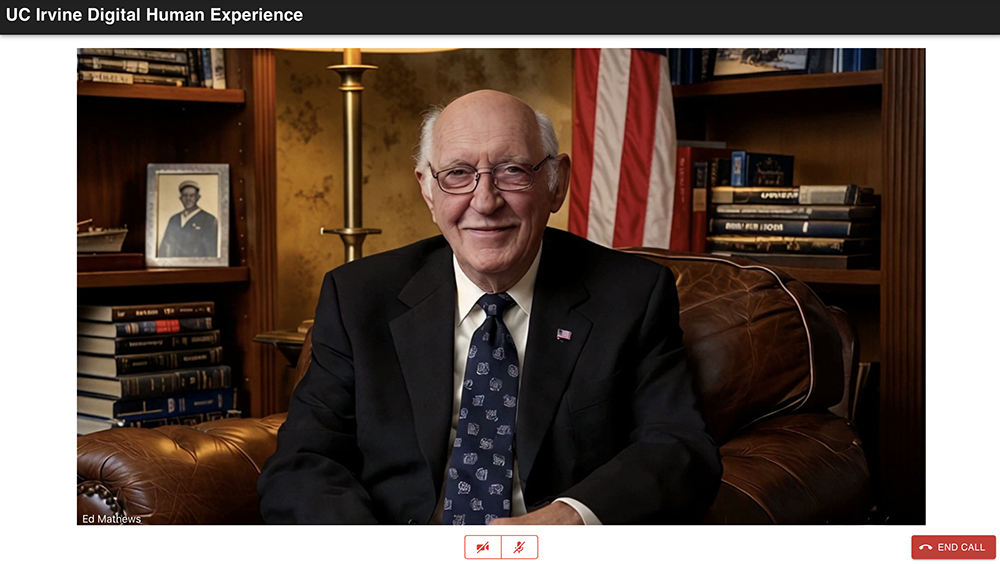
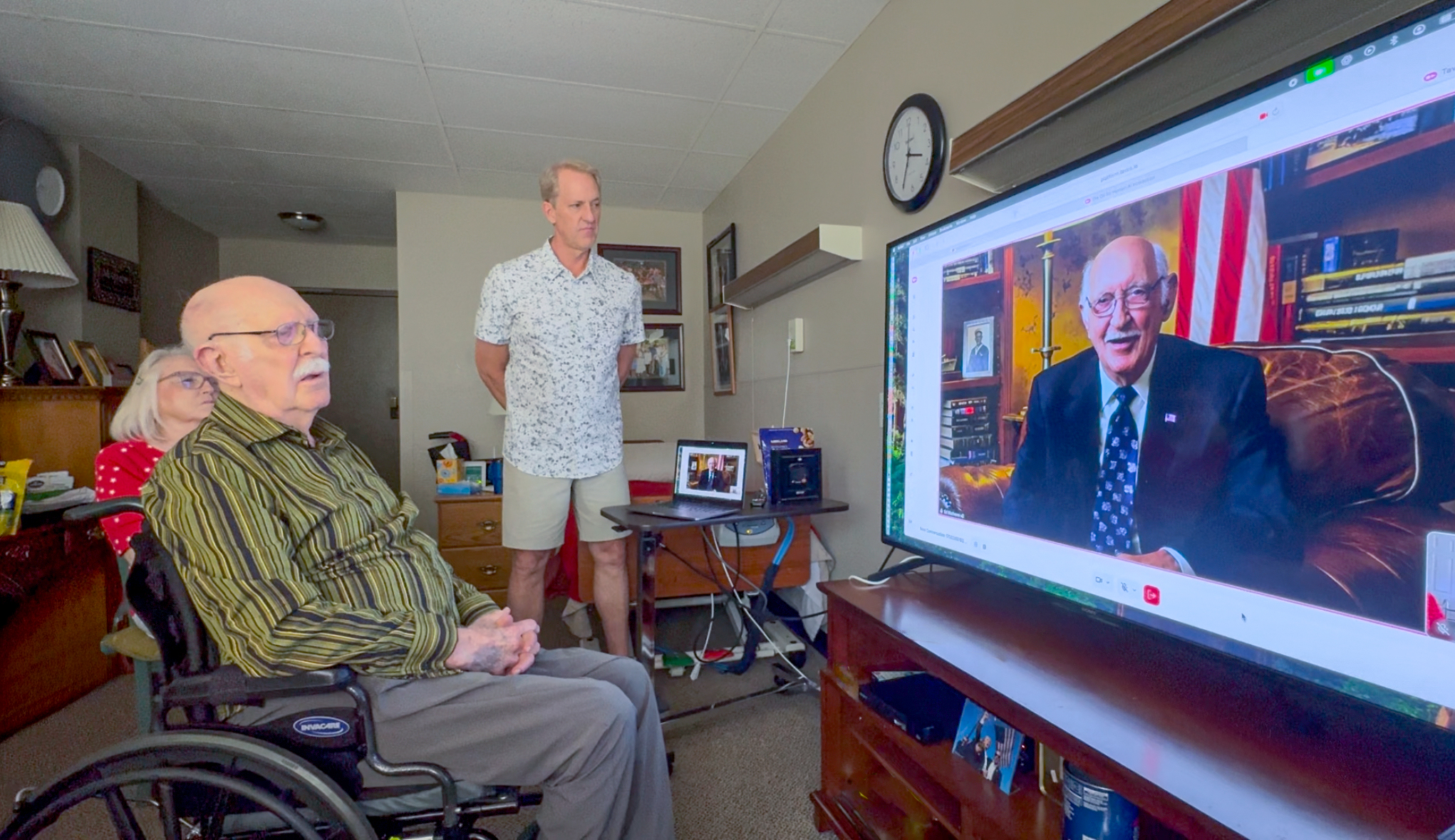
“Elder Wisdom struck us as one of those rare ideas that’s personally resonant and technologically ambitious,” says Errol Arkilic, Chief Innovation Officer at UC Irvine. “It’s not just about AI. It’s about the human impulse to pass down what we’ve learned. We’re always looking for projects that live at the intersection of technology and social value.”
Arkilic’s framing underscores the institutional ambition. But for Mathews, the meaning was much more intimate. The effect was both striking and comforting. It was also unexpectedly practical, as Mathews discovered one afternoon over lunch in San Juan Capistrano, when he and his wife were joking about whether his mother’s return to work when he was a young child explained some of the differences between him and his older brothers. Instead of debating the dates, Mathews pulled out his phone to test his father’s AI avatar. The avatar responded with a level of detail that surprised them both: the year she started teaching, the adjustments the family made, the way his older brothers were “trained” to take on chores. Mathews shared the answer with his siblings. His brother’s reaction was immediate: I need to get my login for this.
The Ed Mathews avatar is a proof of concept, but the implications reach further. Mathews imagines a wide range of uses. A university chancellor who cannot meet with every student but whose published lectures, syllabi, and other writings could be distilled into an avatar to provide 24/7 office hours. In business, a retiring CEO could leave behind not just strategy documents but an interactive persona embodying decades of expertise. Families without a memoirist could build avatars through structured interviews, feeding answers into the system until a likeness emerges. A teacher or mentor could extend their reach in similar ways.
In a sense, Elder Wisdom formalizes what has always been a fragile process. Knowledge is often passed in fragments—over dinner tables, in classrooms, in hurried hallway conversations. While these occurrences are practical and natural, much of the information exchanged this way is lost. What the NarrA.I.tive team proposes is a kind of scaffolding for memory, a way to preserve not only the content of experience but its style: the pauses, the emphases, the fatherly chuckle that turns advice into something less like a lecture and more like a conversation at the kitchen table.
Of course, the project invites questions. Who owns the likeness, the voice, the corpus of a life? Could it mislead, or be misused? And hallucinations, when systems generate plausible but false statements, are a common concern with generative AI.
As Will Douglas Heaven, a senior editor at MIT Technology Review, has noted, hallucination is “a feature, not a bug” of AI. In other words, these models are built to make things up.
But Elder Wisdom, by contrast, is designed to limit invention as much as possible. When asked about something it doesn’t know, or isn’t meant to discuss, like modern politics, the Edward Mathews avatar is engineered to give careful deflections, such as, “I don’t recall precisely,” rather than make something up.
Other institutions have experimented with similar technologies. For example, USC Shoah Foundation’s Dimensions in Testimony enables people to ask questions that prompt responses from Holocaust survivors and other witnesses to genocide from pre-recorded subjects. The Japanese American National Museum has a similar exhibit where visitors can have conversations with WWII veteran Lawson Sakai.
The difference between those exhibits is that they’re limited to prerecorded answers. Elder Wisdom, drawing on a structured database but powered by generative AI, can improvise within boundaries, making the exchange feel less like playback and more like dialogue.
The result, in Mathews’ words, is “special and meaningful.” He recalls testing the avatar by asking about love and marriage. The answer he received was not in the memoir, but it sounded exactly like his father: put love and respect first, share faith, be realistic about compatibility. For Mathews, it was as though the machine had distilled not only words but his father’s character.
“Elder Wisdom struck us as one of those rare ideas that’s personally resonant and technologically ambitious”
– Errol Arkilic, Chief Innovation Officer, UC Irvine
While the potential is broad, the heart of the project remains personal. Mathews speaks about his father’s dozens of grandchildren, his great-grandchildren, and eventual great-great-grandchildren. Few of them will have known Edward well. Yet through Elder Wisdom, they may someday sit down, ask him about his youth, or hear him describe meeting his wife Martha in Kansas City. They may find in his voice an anchor across time and a trace of the past that still answers back.
Yet, Mathews is thinking bigger. He envisions Elder Wisdom as a platform accessible to anyone, akin to Ancestry.com. Families could create avatars of parents or grandparents, layering in diaries, photos, or even social media posts. The system could interview subjects directly, following up when it detects an emotional response, drawing out depth the way a perceptive interviewer might. Over time, a family could build not just a family tree of names but a conversation of voices.
The ambition here is not to replace the living or the act of remembering, but to supplement them. To make legacy interactive, rather than static. It’s tempting to see this as a kind of digital immortality, but Mathews resists that framing. For him, Elder Wisdom is less about eternal life than about continuity. It’s a bridge across the gap where memory usually frays.
When he first spoke to the avatar, Mathews’ emotions were not just for the likeness of his father, but for the relief of having captured something fragile before it disappeared.
The project is young. The system occasionally stumbles over dates or mispronounces acronyms. It is, for now, slower than human conversation, the lag a reminder of the machinery beneath. But it’s also, already, capable of moving people to tears. Mathews has seen it happen in demonstrations, when colleagues or visitors hear his father speak and are jolted into remembering their own.
They’ve told him that they want this of their fathers.
The value of Elder Wisdom is less in its novelty than in its continuity. It reframes memory as exchange, and knowledge as something not stored but spoken. We spend our lives trying to capture meaning; here is one way to ensure it endures, circulating across families, across generations, across lives yet to come. What we learn doesn’t have to fade. It can remain, waiting to be shared.
Interested in the Elder Wisdom platform? Reach out to Stuart Mathews.
To support NarrA.I.tive contact Grace Han.