
UC Irvine startup StoryAI is designed to help young writers find their ideas without taking over the page
A student sits in front of a blank page. The screen glares back at them. The cursor blinks. Minutes pass. And then a few more. Kylie Peppler knows this moment well, from classrooms and her own kitchen table.
“A lot of kids will just sit and stare at the blank page,” she said. “Part of the reason they feel like they can’t write is that they spend a lot of time not writing.”
Sometimes the hardest part of writing is writing anything at all. Peppler, a UC Irvine professor in the departments of Informatics and Education, and her team have created StoryAI, a writing assistant designed to fill that page with the student’s own words.
The Problem with Too Much Help
The problem with AI is that it writes too much, too quickly, too well. If you ask a general-purpose chatbot for help with an essay, it will provide you with a polished draft. For an adult trying to clean up a memo, that efficiency can be useful. But for a child learning how to turn an idea into a sentence and build that sentence into a paragraph, it skips all the parts that matter most.
“A lot of commercial tools tend to do too much for the learner,” Peppler said.
This is also not how a good teacher works. A teacher might help a student imagine a character before writing a story. They might ask what the character sees or smells or help the student tease out a detail worth pursuing. “A teacher wouldn’t just put a story up on the board and say, ‘Here it is,’” Peppler said.
StoryAI slows the process down. It prompts students to develop an idea, make choices and put their own words on the page. Peppler said that with some commercial tools used by college students, AI was producing 90% to 95% of the work. In the team’s early research, students using StoryAI produced writing that was two to three times longer, and the AI contributed only about 3% to 4% of the work.
Peppler’s team also studied how teachers, students and parents felt about AI in the classroom. Parents were the most skeptical. Their main concern was cognitive offloading, or the possibility that their children could turn over the writing and the thinking it requires.
“The devil is in the details of how you design these tools,” Peppler said.
Building Teacher Knowledge Into AI
The StoryAI team initially imagined a tool that could be used in libraries or in the home. One of the project’s lead developers, Ariel Han, a native Korean speaker, inspired the platform. She knew academic English but struggled to help her daughter with the writing assignments she brought home. Knowing a language and knowing how to teach a child to write in it were different problems.
Her experience kept the team focused on multilingual families as it developed the project. StoryAI now supports more than 100 languages, along with speech-to-text and text-to-speech. The features can help students whose first language is not English, as well as children with dyslexia, dysgraphia or other barriers that can make getting words onto a page difficult.
To figure out where StoryAI might be most useful, the researchers turned to teachers. They worked with roughly 70 teachers, interviewing them and observing how they taught. Through the National Science Foundation’s I-Corps program, which helps researchers test the commercial potential of their work, the team narrowed its focus to schools. Teachers had plenty of tools for reading but considerably less support for teaching writing. But writing instruction also had to adapt to what a teacher was trying to teach, which was not something a general chatbot provided.
StoryAI team built a back end that gives teachers control over the assistant. A teacher working on vocabulary, for example, can enter the week’s words. If a student writes “big” when “humongous” is on the list, StoryAI can nudge the student toward the new word. Teachers can set themes and lesson goals, adjust difficulty by grade level and configure age-appropriate content. The platform has also expanded beyond fiction to support different kinds of writing, including the familiar five-paragraph essay.
Part of that development took place with support from UC Irvine Beall Applied Innovation’s Proof of Product (PoP) grant. The team worked directly with teachers and students to shape the platform, using their feedback to refine lessons and build features teachers could control. They added secure sign-on, separate teacher and student accounts, lesson development tools and ways to collect data about how students were using the platform.
“Most platforms are designed by corporations and trained on the internet writ large,” Peppler said. “Our platform, by contrast, is trained on early childhood writing and teachers’ best practices.”
A Little Less Smart
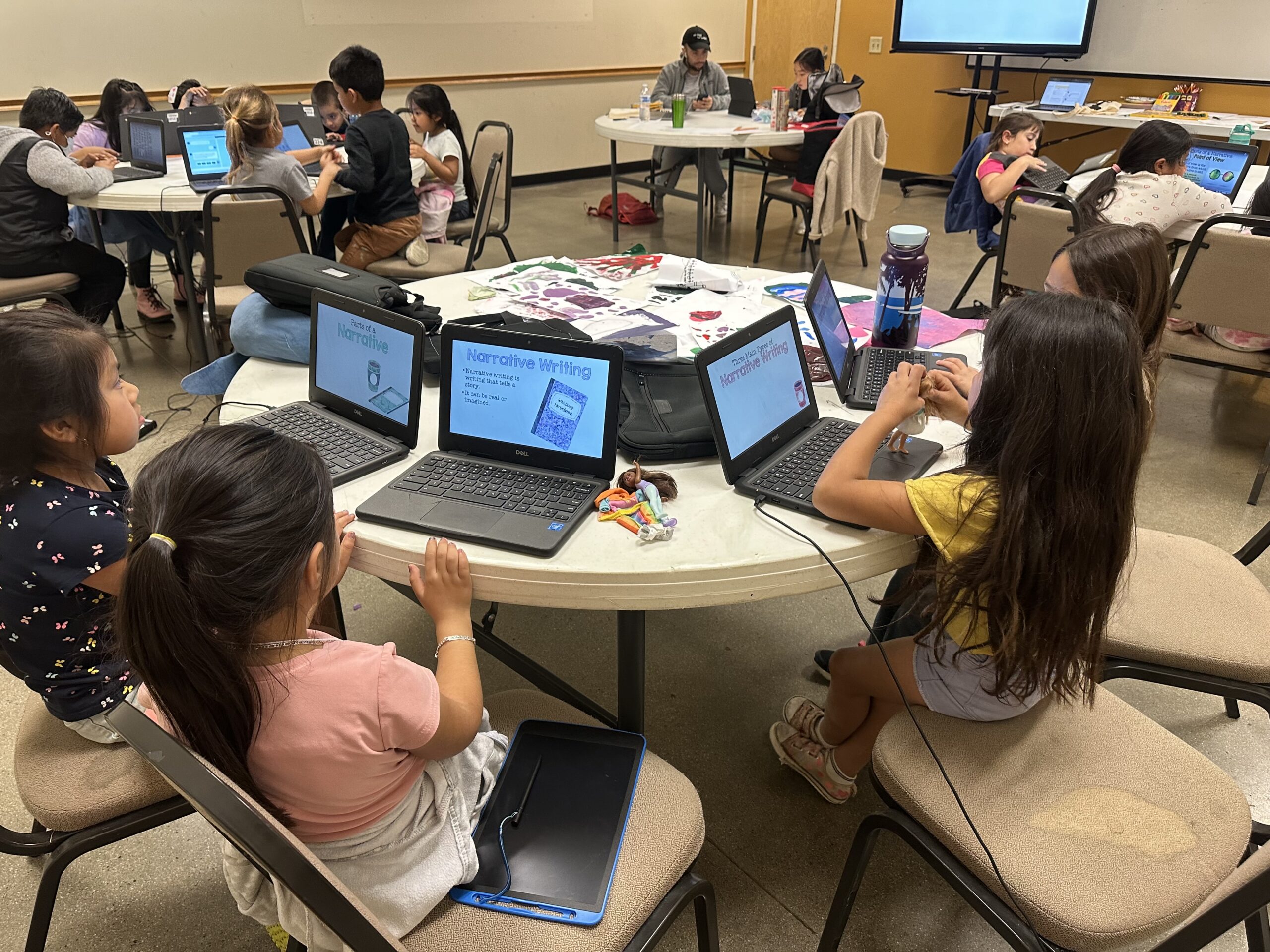
StoryAI’s screen is divided in two. On the left, students interact with the chatbot as they work through an idea. On the right, they write and rearrange their draft. Peppler describes the interface as “a mix between Microsoft Word and an LLM,” or large language model, the technology behind chatbots such as ChatGPT.
A typical chatbot will rewrite an entire response each time it receives a new prompt. In StoryAI, the draft remains separate and in the student’s control. The assistant is nearby, asking questions and suggesting possibilities. It also occasionally gets things wrong.
These mistakes have turned out to be useful. Peppler has watched students push back when the AI misunderstands a character or takes a story somewhere they never intended. Peppler said students often protest with something like, “Oh my gosh, no, that wasn’t it at all. That’s not Fluffy Bunny.” The interruption can jolt a student into explaining an idea more carefully. It can also be funny.
“Sometimes when the AI is too perfect, it takes away these playful moments,” she said.
Even the platform’s appearance has a homegrown quality, which Peppler said was intentional. A slick design may give the machine an authority the researchers do not want it to have. A student who catches the chatbot getting Fluffy Bunny wrong has to decide that their own idea is the right one.
The 21st Idea
Peppler thinks about creativity as a practice. Exposure, repetition, collaboration and the freedom to try something that may go nowhere make a difference. Stress can narrow creative possibilities. Feedback and iteration can open them up again. “Creativity is malleable and not fixed,” she said. “The more we do something, the more creative we become over time.”
Peppler offers an everyday example of how AI can provide options. Ask a chatbot for 20 birthday party ideas, she said, and her children would probably veto every one. Yet somewhere in rejecting those suggestions, they might invent a 21st idea that they like.
Peppler applies a more demanding version of the exercise to her graduate students. She asks them to generate 100 possible dissertation ideas before settling on one. Only one of her students has actually returned with all 100, but most come up with at least 30 or 40. By then, the idea they first arrived with often no longer looks like the best one. Another has taken its place, or two have combined into something stronger.
That messy stretch is where AI can help. Generating ideas is only part of the creative process. The other part is judgment, deciding what to discard, what to combine and which ideas deserve to go further.
Peppler has studied technology and creativity for decades. She was part of the educational team that helped with the original design of Scratch, the programming platform developed through a collaboration between MIT and UCLA that has since reached more than 220 million children. At one stage, children began calling Scratch “paper” because they felt they could make whatever they wanted with it. Peppler is after the same thing with StoryAI.
“How do we make sure we don’t erase kids’ own ideas and thinking, so the work still feels like an expression of themselves?” she said.
Where the Story Leads
The team is now testing StoryAI in other areas of learning. Another of Peppler’s graduate students, Shenshen Han, has been exploring how StoryAI’s approach could help children work through math word problems, a challenge familiar to many. Before students can solve the equation, they have to figure out what the problem is asking, which numbers matter and how the pieces fit together.
The work has led Peppler’s team toward writing across the curriculum, exploring how the same process students use to develop a story might also help them break down other types of work. Waste to Wisdom, an emerging StoryAI initiative, takes the idea further. It uses storytelling to help students understand sustainability and complex systems. Students might investigate food waste or the life cycle of clothing by using data from their own lives alongside publicly available information. They would then use storytelling to make the systems and evidence more understandable.
Peppler has been thinking about how narrative shapes the way children understand systems. The project encourages students to build stories around cycles and consequences. The standard Western story tends to travel linearly toward a resolution. There is a beginning, middle and end. Many Indigenous and non-Western storytelling traditions, she said, are better at representing cycles and interdependence. A children’s book such as “If You Give a Mouse a Cookie” offers a good example. One action leads to another, which leads to another, until the story circles back to where it began.
The ideas behind StoryAI are expanding, and its path beyond the university is still taking shape. Grants, corporate gifts and UC Irvine support are keeping the platform running and funding its development. UC Irvine Beall Applied Innovation has helped initiate conversations with companies that might eventually incorporate StoryAI into a larger organization. Meanwhile, teachers continue to discover the platform through conferences and word of mouth.
While StoryAI’s next chapter remains unwritten, the project continues to test what educational AI could look like. Peppler cares less about the technology than about what children do with it. “I tell my kids I want them to be producers more than I want them to be consumers,” she said.
Her children have taken the idea further. Over dinner, they have debated whether something made largely by AI should be called “generated” rather than “created.” It is a heady distinction for a family meal, and one that has shaped StoryAI from the start. The technology may offer possibilities, but learning still requires children to decide what they want their words to say.