
That kind of output wouldn’t just meet our energy needs—it would erase the idea of energy scarcity altogether. For industrialized nations, fusion could mean an unlimited energy supply for data centers and electric vehicles while reducing reliance on imported fuel. For developing nations, this could be even more transformative: affordable electricity for hospitals, schools, and water treatment facilities. It would enable countries to leapfrog traditional energy grids without adding to global emissions.
And unlike coal, gas, or nuclear fission, fusion is clean. It doesn’t produce long-lived radioactive waste or carbon emissions. It wouldn’t just reduce pollution; it could erase the need for fossil fuels entirely. That’s why fusion has been called the “Holy Grail” of clean energy.
But if fusion sounds too good to be true, that’s because it has been. Scientists have been chasing fusion energy since the mid-20th century. That’s perhaps why the running joke about nuclear fusion is that it’s always 20 (or 30 or 50) years away and always will be. For decades, the idea of birthing a star on Earth has felt quixotic, something closer to science fiction than reality.
But lately, that timeline has started to feel less like a punchline and more like a serious possibility. The shift isn’t just technological, but political, economic, and existential. Over the past 70 years, we have burned through more energy than the previous 11,700 years combined. By 2050, the global population is expected to reach 9.7 billion. And while that’s about a 20% increase in population, it’s expected the demand for energy will increase by 50% over this time. Scientists are already predicting that in the next couple of years, AI will consume as much electricity as a medium sized country. As demand and the climate crisis accelerates the need for reliable, carbon-free energy, fusion has moved from the fringes of scientific ambition to a viable solution.
One of the biggest players in the fusion energy space is TAE Technologies. Spun out of UC Irvine research in 1998, the company has spent decades refining its approach inside an unassuming warehouse in Foothill Ranch, CA, where its reactors routinely generate temperatures hotter than the sun. In 2015, Time Magazine was so enthralled by TAE’s potential, they put the company on its cover. A decade later, TAE remains a leader in what might be one of the most transformative energy bets of the 21st century.
TAE is led by Michl Binderbauer (pronounced Michael), who earned both his B.A. in physics (1991) and Ph.D. in physics (1996) from UC Irvine before going on to co-found the company. Over the years, Binderbauer has worn many hats at TAE—chief technology officer, president, and now CEO. Binderbauer’s leadership has been instrumental in shaping TAE’s success, guiding the company from a bold idea to a major player in the fusion industry.
“Whatever we do, it has to be in service of an end goal… If it doesn’t, we shouldn’t work on it.”

TAE’s technology is based on concepts developed by pioneering UC Irvine physicist and TAE co-founder, Norman Rostoker. Rostoker, who passed away in 2014, is considered the father of breakthrough nuclear fusion techniques and was amongst the first generation of pioneers working in fusion energy. Rostoker was part of the wave of elite scientists who opened laboratories after the U.S., U.K., and Soviet Union declassified much of their fusion research as part of the Second International Conference on the Peaceful Uses of Atomic Energy in 1958.
Rostoker joined the UC Irvine faculty in 1972 where he became chair of the physics department later that year. But Rostoker wasn’t just a theorist, he cared deeply about making fusion a real, practical source of energy.
“Many academics are very content with their work living on paper or in a lab, but Norman was committed to the practical application of his work. ‘Whatever we do, it has to be in service of an end goal,’ he said. ‘If it doesn’t, we shouldn’t work on it,’” says Binderbauer, who was Rostoker’s protege.
Rostoker’s brilliance also extended to the way he connected with people.
“Not only was he an academic genius, but his technical skill was paired with an incredible amount of humanity,” says Binderbauer.
Perhaps that’s why Rostoker cared so much about making fusion a reality. He didn’t just see it as a scientific breakthrough, he saw it as something that could improve lives.
TAE’s relationship with UC Irvine has been a critical cornerstone of the company’s development. The relationship has been characterized by deep mutual support and collaboration. From the earliest days, the university provided the company with credibility, resources, and an innovative ecosystem that enabled the company’s growth.
“The fact that UCI was willing to put its stamp of approval on us gave us a credibility that was way beyond what we could have received on our own,” says Binderbauer.
The university also served as a talent pipeline, with TAE sponsoring numerous graduate students, providing internships, and even establishing an endowed chair in physics in Rostoker’s name. In return, TAE offered UCI-affiliated researchers unique opportunities to work on cutting-edge fusion technology, created pathways for student employment, and brought significant research funding and prestige to the campus. Binderbauer also serves on UC Irvine’s School of Physical Sciences Deans Executive Cabinet.
Binderbauer describes the relationship between TAE and UC Irvine as a “virtuous feedback loop,” where both the company and the university benefited from each other’s innovative spirit and commitment to transformative scientific research.
This collaborative exchange has advanced fusion research and underscores the complexity of the challenge at hand. After all, there’s a reason fusion has always been “just 20 years away.”
First, it’s really hard to fuse atoms. When the nuclei of hydrogen atoms combine, a small amount of mass is lost and converted into a huge amount of energy. This reaction is explained by Einstein’s famous theory of relativity and the equation E=mc².
The problem with recreating this reaction on Earth is that atomic nuclei are both positively charged, which means they naturally repel each other. Overcoming this repulsion requires a huge amount of heat and pressure. At extreme temperatures, atoms shed their electrons and turn into plasma, a super-hot electrified state that’s not quite a gas, but more like a wild, high-energy blob of positive and negatively charged particles. Binderbauer likens plasma to a hot oozy ball of Jell-O.
To further complicate this matter, once you’ve performed the miracle of creating a star on earth, you have to figure out how to contain it. In space, stars hold themselves together with gravity and their shear mass. Down on earth, we don’t have this luxury.
The moment that hot oozy ball of Jell-O touches anything cooler and denser, it loses heat and fizzles out. So, what makes this so difficult, is also what makes it so safe. If something goes wrong, the reaction just stops. There are no meltdowns or disasters. It’s just a star quietly turning itself off.
Another reason fusion has faced an uphill battle is that it has inherited a difficult PR campaign. Up till recently, the word “nuclear” has come with a lot of baggage. Fusion tends to be confused with fission, fusion’s disaster susceptible counterpart (think Three-Mile Island, Chernobyl, and Fukushima), and the only type of nuclear power we currently have on earth.
But fusion and fission are fundamentally opposite mechanisms. While fission splits large atoms apart, fusion smashes small atoms together. While fission relies on uranium, a rare, radioactive fuel that leaves behind hazardous waste, fusion uses hydrogen, the most abundant element in the universe that doesn’t produce any long-lived radioactive byproduct. What’s more, fusion isn’t just cleaner, it’s way more powerful. It generates about three to four times as much energy as fission. It’s no wonder scientists are racing to make it work.
The vast majority of fusion research and companies focus on magnetic confinement fusion, a technique that traps superheated plasma using powerful magnets inside a toroidal—or doughnut-shaped—reactor. The two leading designs, tokamaks (a term derived from a Russian acronym) and stellarators, are built to sustain the extreme conditions required for fusion. These reactors typically rely on deuterium and tritium (D-T fusion)—two isotopes of hydrogen that fuse at a relatively lower temperature of around 100 million degrees Celsius. Among the various fusion approaches, D-T fusion remains the most extensively studied and widely pursued path to commercial energy production.
Despite its promise, D-T fusion comes with challenges. The reaction generates high-energy neutrons, leading to some radioactive byproducts (though unlike nuclear fission, these materials require storage for decades rather than millennia). And over time, neutron exposure wears down reactor components, which necessitates protective shielding and drives up maintenance costs.
Tritium poses another complication—it’s rare in nature and must be continuously bred within the reactor to sustain supply. Yet, despite these hurdles, D-T fusion remains one of the most promising paths to clean energy. It’s far safer and cleaner than fossil fuels or nuclear fission, and if scientists can overcome the remaining technical barriers, it could unlock a virtually limitless source of energy.
“The science and engineering have now reached the level needed to converge for success. I’m confident it’ll happen in less than 10 years.”
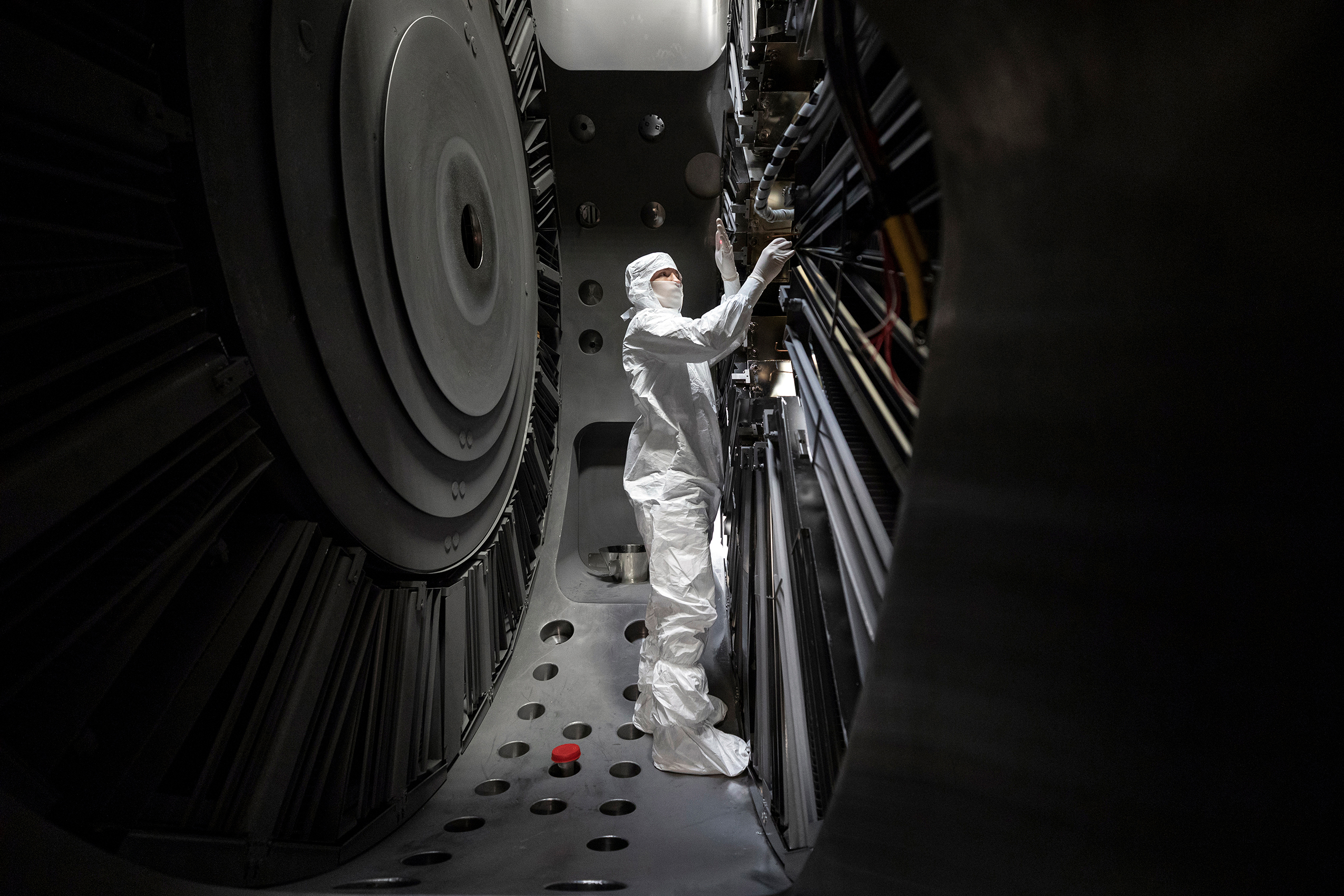
TAE is taking a different path. The company has built its technology around an aneutronic, beam-driven fusion method first developed by Rostoker. Instead of using massive superconducting magnets like those found in tokamaks, TAE employs field-reversed configuration (FRC) fusion, where a combination of self-generated magnetic fields and high-energy particle beams helps keep the plasma stable. This method works a bit like a spinning top—as long as the plasma receives small, precise nudges from high-energy particle beams, it remains stable and contained.
While TAE’s technology could readily support conventional D-T fusion, the company is instead placing its bet on hydrogen-boron (p-B11) fuel. Both elements are naturally abundant, and—more importantly—this approach avoids producing high-energy neutrons, which means there’s virtually no radioactive waste. The trade-off to this is heat—like a crazy amount of heat. p-B11 fusion requires temperatures on the order of 1 billion degrees Celsius. That’s two orders of magnitude hotter than the Sun’s core which, by comparison, is relatively mild at a mere 15 million degrees.
With Norman—TAE’s fusion reactor, named after Rostoker and one of the most modern and the largest fusion reactor in the U.S.—the company has proven its approach works, successfully confining plasma at 75 million degrees. If Norman was the proof of concept, Copernicus is the next big leap. Now, TAE is setting their sights on the ultimate milestone: net energy gain. That’s exactly what their sixth device, Copernicus, is designed to achieve. And based on everything they’ve built so far, they believe they’re on the right track.
That belief was further reinforced by TAE’s latest breakthrough: a streamlined reactor called Norm. Announced in April 2025 and published in Nature Communications, Norm simplifies how fusion plasma is formed and controlled—relying entirely on a “neutral beam only” method that eliminates the need for complex plasma formation hardware. The result is a smaller, less expensive, and more efficient machine that not only improves performance, but also slashes reactor cost and complexity by up to 50%. Norm routinely delivers TAE’s highest steady-state plasma performance to date and has already validated key components and operating modes for Copernicus. In short, the road to net energy just got shorter.
Even with this progress, the road ahead remains steep. Fusion’s most daunting challenge—reaching the extreme temperatures required for p-B11 fuel—still lies ahead. For decades, this temperature barrier made p-B11 fusion seem out of reach. But if TAE can crack the code, the payoff would change our world as we know it by creating a cleaner, safer, and potentially more cost-effective fusion model, free of neutron byproducts or even short-term radioactive waste. That could make fusion power plants not only viable, but scalable—a breakthrough with the potential to redefine the global energy landscape.
This is probably why so many high-profile investors are paying attention to TAE and putting serious money behind it. Backers include Paul Allen, the late co-founder of Microsoft; Venrock, the venture capital firm established by the Rockefeller family; Google; Chevron; Sumitomo Corporation of Americas; NEA, Wellcome Trust; the visionary family offices of Addison Fischer; the Samberg Family Foundation; and others.
According to the Fusions Industry Association, private investors have poured $7.1 billion into fusion research since 1992. Of this, TAE alone has raised over $1.3 billion, making it one of the best-funded private fusion companies in the world.
TAE has also assembled an impressive board of scientific and industry leaders. When Rostoker co-founded the company, Nobel Prize winner Glenn Seaborg served as its first Chairman of the Board. Other notable board members, past and present, include former U.S. Secretary of Energy Ernest Moniz, former CEO of General Electric (GE) Jeffrey Immelt, former President and CEO of Electric Power Research Institute (EPRI), former President of GE Nuclear Energy Steve Specker, and founder of Pequot Capital Art Samberg. The board also featured astronaut Buzz Aldrin, and—perhaps most unexpectedly—actor Harry Hamlin of L.A. Law fame, who is also a company co-founder.
Rostoker’s influence didn’t stop with his own research—his students have made a lasting impact on the fusion field as well. In addition to Binderbauer, Toshiki Tajima, one of Rostoker’s early Ph.D. student, went on to become Chief Science Officer of TAE and the first Norman Rostoker Chair in Applied Physics at UC Irvine. (Tajima has also played a part in international fusion history: prior to the 1977 treaty between the U.S. and Japan to begin joint research on fusion, Tajima advised Prime Minister Takeo Fukada on the benefits of fusion energy.)
TAE Technologies’ innovations in fusion research have led to breakthroughs beyond energy, giving rise to two subsidiary companies: TAE Life Sciences and TAE Power Solutions. Both ventures apply TAE’s core technologies to new industries, demonstrating how fusion-related advancements can have wide-ranging impacts.
TAE isn’t alone in the race for fusion. In the U.S. alone, more than 25 private companies are chasing this goal. The U.K., Canada, and China also all have notable teams trying to provide fusion power to the masses. Binderbauer has recently spoken on CNBC about how the U.S. is losing ground to China. In the past, he has also likened the quest for fusion to the race to the moon in the mid-20th century.
For decades, fusion has lived in the realm of scientific ambition—always just “20 years away.” But the churn of scientific progress has given way to a surge of investment, breakthroughs, and a growing sense that this time, fusion might actually be different.
“That’s the beauty of today,” Binderbauer says. “The science and engineering have now reached the level needed to converge for success. I’m confident it’ll happen in less than 10 years. And I think there’s a very good shot that TAE or one of the other larger and more mature private companies could make that happen within three to five years.”
Those in the industry are also optimistic. In a 2024 survey by the Fusion Industry Association, 89% of responding companies predicted that fusion would provide grid electricity by the end of the 2030s. Most saw it happening by 2035.
The dream of fusion has always felt just out of reach. But today, that dream is closer than ever. With cutting-edge technology, unprecedented investment, and companies like TAE pushing boundaries, the fusion race is heating up. The next few years could determine whether fusion finally breaks free from its “always 20 years away” reputation and becomes the energy breakthrough the world has been waiting for. If TAE succeeds, they won’t just rewrite the future of energy—they’ll redefine what’s possible.